Wednesday, October 29, 2025

The Solution to Dioceses' Parish Closures: Close the Chancery!

It is unjust and wrong-headed for American Catholic Bishops who have large and very expensive chanceries (with dozens of full-time employees and very expensive upkeep on the building and maintenance personnel) to tax the parishes of the diocese and to close parishes.

The bishop and the bishop's office should be self-sufficient. The Ordinary of the diocese should not tax the parishes. His expenses (and all of the expenses of the diocese) should be paid for by benefices separate from the parishes and apostolates, and from free-will benefactors. Stop squeezing the parishes. Close and sell the chanceries, not the parishes!

Furthermore, the criminal cases against priests and bishops should not be paid for by any money of the Church, the diocesan money or the parish money, none of which belongs to the priests or bishops. That money belongs to the people of God who freely gave it for divine worship, for the sustenance of the clergy, and for the assistance of the poor. All money thus wrongfully taken from the Church in the past three decades should be given back by the courts and by the State to right this great wrong. Individual criminals should pay for their crimes from their own assets, not from those of the Church or Parishes.

--Plinthos

Tuesday, October 28, 2025

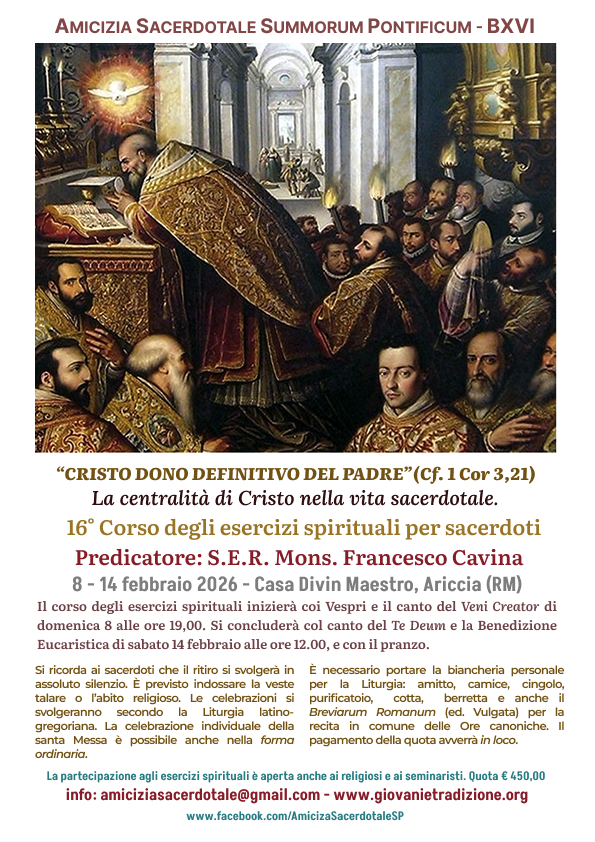
Traditional Retreat for Priests, Castel Gandolfo (Italiano)


The location of the retreat, Casa Divin Maestro, Ariccia, is on Lake Albano, in the neighborhood of Castel Gondolfo, just outside of Rome. It is a retreat house which belongs to "The Pauline Family."

Below is Plinthos' translation of the announcement, with correction of some typo's.


AMICIZIA SACERDOTALE SUMMORUM PONTIFICUM - BXVI
 
"Christ the Definitive Gift of the Father" (Cf. I Cor. 3:21)
The Centrality of Christ in priestly life.
16th Annual Retreat for Priests
 Retreat Master: His Excellency Bishop Francesco Cavina
8-14 February 2026 - Casa Divin Maestro, Ariccia (Roma)

The retreat will begin with Vespers and the chanting of the Veni Creator of Sunday, 8th of February at 7PM. It will conclude with the chanting of the Te Deum and Benediction of the Blessed Sacrament on Saturday, the 14th at 12 Noon, and with lunch (pranzo).

The priests are reminded that the retreat will be in absolute silence. The use of the cassock or religious habit is expected. The liturgical celebrations will be according to the Latin-Gregorian Liturgy (1962, Extraordinary Form). The individual celebration of holy Mass will also be possible in the Ordinary Form). It is necessary to bring one's own personal liturgical effects: amice, alb, cinture, purificator, surplice, biretta and also the Breviary (Breviarium Romanum [Vulgate edition] for the recitation of the canonical hours of the Breviary in common. Payment for the retreat will be done at the retreat house.

Participation in the retreat is also open to religious and seminarians. Cost is 450 euro.
Info: amiciziasacerdotale@gmail.com - www.giovanietradizione.org

Sunday, October 26, 2025

Dilexi te, Francis (English/Spanish)


October 26, 2025

In my previous article, I addressed the form of the apostolic exhortation Dilexi te, since it constitutes the first official document of our new pope. My focus was chiefly on the biblical quotations—beginning with the very title, drawn from the Book of Revelation—where one perceives a deliberate effort to make Scripture say whatever serves the intention of the document. And no, it does not make a good impression to see the sacred text being forced in that way. When Scripture is treated so, there is no longer any certainty that one understands something as simple as the Gospel itself. That this method has become the Vatican’s new exegetical style inspires not the slightest confidence. Such was my concern in my earlier commentary on the form of the exhortation.

Turning now to the content of the document, upon reading and rereading it I have been left with the disquieting impression that I was before an intentionally discreet and moderate justification of the now-defunct Liberation Theology—one in which Pope Francis himself was once deeply immersed; to a lesser extent the current pope, and generally much of the Latin American clergy, with the Society of Jesus conducting the orchestra. Hence I cannot rid myself of the thought that, in truth, Dilexi te is directed not to us, but to the previous pope—Francis.

Why do I hold such an impression? Simply because this discourse of “assistance to the poor” has long since been exhausted; it is clearly not the front on which the Church must fight to spread the Gospel. The Church’s charitable service, from her foundation, had full meaning when no one else attended to the needs of the poor. In that context, mere material aid was, in itself, a sublime function—even when deprived of the animating soul of Christian charity that should have given it life.

Even in more modern times, the Church’s “charitable” approach retained some sense when it served as a lever for evangelization. But once the Catholic Church found herself facing the competition of Protestants, Anglicans, and others—and, above all, once she confronted the competition of the welfare state (so elegantly styled the Social State)—her purely assistential function, stripped of the spirit of fraternal charity born of love for God and from God, entirely lost its reason for being. All the more so after Pope Francis’s categorical admonition that the members of the Church should flee from proselytism—that is, from evangelization itself—thus depriving the poor of the greatest gift the Church can offer them: the Gospel in all its richness. It is worth recalling this point, given that the document was purportedly authored by Francis, while his successor, Leo XIV, merely revised and ratified it with his signature. It sounds, unmistakably, like a gesture of fidelity to Francis.

And I believe this document arrives far too late. The care of the poor is now administered by governments, funded by taxes, and by unreliable NGOs led by such philanthropists as Soros, Bill Gates, Rockefeller, and others of similar intent. In my view, the Church has no place in that competition—hardly transparent, to say the least—among the actors of secular “solidarity.” The Church’s presence makes sense only if her distinguishing mark is charity: a charity that attends not only to material needs but to spiritual ones as well—chief among them, offering the poor God Himself, our Redeemer made man. Otherwise, it is a waste of time for priests—few as they now are—to devote themselves to such material functions, which the State performs more effectively, while so immense a spiritual task remains at their charge. In the early Church, the care of the poor was entrusted to the diaconate. Have we already forgotten that? Thus the document appears gravely misdirected and ill-suited to the Church’s present moment. It is not the materially poor who are lacking today.

The situation is further aggravated by the transformation of Caritas—a once deeply Catholic institution of charity—into a mere provider of social assistance, now serving as an intermediary for European Union funds, to such an extent that certain municipalities seek to expel the Church from its own creation. The bulk of what Caritas distributes today comes from those sources. And in order not to offend the recipients of aid, who are only a minority Catholic, most Caritas centers—lest they disturb non-Catholics—have removed crucifixes and all religious symbols. Evangelization and proselytism are, of course, excluded, in obedience to the will of the pope who authored most of this apostolic exhortation. The obvious question then arises: what role has the Catholic Church in this activity, if lay and secular bodies are already handling it? What are priests doing there, when their numbers are too few even to fulfill their strictly spiritual duties?

It is true that the Church pioneered social assistance and maintained its most effective institutions with Catholic personnel—especially religious sisters. But she was also the founder of hospitals, and yet no longer insists on leading them (save for the Brothers of St. John of God, whose institutions grow ever less Catholic). The Church was likewise the originator of the Montes de Piedad—charitable loan houses—in which she played an important role until less than a century ago. But no one today demands her return to that sphere. She was once a pillar of education, too, when public institutions could not meet that need, and evangelized intensely through her schools: every teacher a religious man or woman. But today, it would be absurd to reclaim the Church’s role in education, which has been reduced to a mere business for religious orders—devoid of the slightest evangelizing intent or capacity—and all of them now in visible decline. Under such conditions, what sense would it make to reclaim education for the Church?

Thus, to demand today that the Church act once again as a distributor of aid to the poor, without insisting on the indispensable condition of Christian charity—that is, evangelizing charity—is to situate oneself wholly outside reality. It would be as anachronistic as demanding the Church’s return to her long-extinct role in education.

And this, precisely, is what the exhortation Dilexi te by Popes Francis and Leo sounds like to me: an anachronism. Worse still, the text bears the stale imprint of the now obsolete conception—within the Church—of social justice as the only legitimate form of charity toward the poor: not to relieve their suffering, but to help them overturn the social order. This was the battle horse of Liberation Theology—led, of course, by the Jesuits!—with all the political confrontation it entailed, even to the taking up of arms. Yes, to impose by the sword (sometimes wielded by zealous clergy) the Christian “charity” of the so-called “preferential option for the poor.” What a monstrosity!

Leaving aside the doctrinal content of the document, it stands as Pope Leo XIV’s clearest proclamation urbi et orbi that, for the present (and God will decide the future), Leo XIV represents a direct continuity with Francis—Dilexi te: “I have loved you, Francis.” Yet Francis was not distinguished by his work for unity within the Church; he opposed mission itself, which Pope Leo proclaims as one of the pillars of his pontificate. At least this is what appears from the new pope’s brilliant maneuver of endorsing a document of his predecessor whose doctrinal content, by its strong mark of continuity, hinders the Church’s unity. In any case, we must concede that he knows the Church’s state better than we do; and perhaps this, despite everything, and for the moment, is the only course open to him—not the best, but the only one. God knows.

It is most enlightening, after a careful reading of Dilexi te, to listen again to the first words spoken by Leo XIV after the Habemus papam: continuity and coherence—Leo XIV with himself and with Francis. It will be difficult to maintain peace (the new pope’s first words), when his predecessor loved it so little.

Virtelius Temerarius

(Translation by Chat GPT)

__

Original Spanish text.

Me ocupé, en el artículo anterior, de la forma de la exhortación apostólica Dilexi te, por tratarse del primer documento oficial de nuestro nuevo papa. Y atendí básicamente a las citas bíblicas, empezando por el propio título, sacado del Apocalipsis, en las que se hace evidente el esfuerzo por hacerle decir a la Biblia todo lo que conviene a la intención del documento. Y no, no causa buena impresión ver cómo se fuerza el sentido de los textos bíblicos. Así no hay manera de estar seguro de que uno entiende algo tan sencillo como el Evangelio. Y que éste haya acabado siendo el nuevo estilo exegético del Vaticano, no nos inspira la menor confianza. Bien, eso en cuanto a la forma, de la que me ocupé en el artículo anterior.
Pero en cuanto al contenido del documento, al leerlo y releerlo, he tenido la impresión desagradable de que estaba ante una justificación intencionalmente discreta y moderada de la extinta Teología de la Liberación en la que estuvo sumergido el papa Francisco; en menor medida el actual papa, y en general todo el clero de Hispanoamérica, además de la Compañía de Jesús llevando la batuta. Con lo que no se me quita de la cabeza lo de que en realidad, el Dilexi te está dirigido al papa anterior, a Francisco.
¿Por qué he tenido esa impresión? Pues sencillamente porque ese discurso asistencial de la asistencia a los pobres, está ya totalmente quemado; y no es, evidentemente, el frente en el que ha de luchar la Iglesia para difundir el Evangelio. El mero servicio asistencial de la Iglesia desde su fundación, tuvo su plena razón de ser cuando no había nadie más que atendiese a las necesidades de los pobres. En ese contexto, la mera asistencia material tenía una función que resultaba de por sí sublime, aunque estuviese desprovista del alma de la caridad con que tenía que ser vivificada.
Incluso en tiempos más modernos, el estilo “asistencial” de la Iglesia, aún tenía algún sentido cuando era la palanca para la evangelización. Pero desde que la Iglesia católica se enfrentó a la competencia de los protestantes, los anglicanos y demás; y sobre todo desde que se enfrentó la Iglesia con la competencia del Estado Asistencial, conocido con el elegante nombre de Estado del Bienestar, la función meramente asistencial de la Iglesia, sobre todo despojada de su sentido de “caridad” entre hermanos, emanada del Amor de Dios y del Amor a Dios, perdió totalmente su razón de ser. A mayor razón, a partir de la postura tajante del papa Francisco, de que los miembros de la Iglesia tenían que huir del proselitismo, ¡es decir de la evangelización!, negándoles a los pobres el mayor don que puede ofrecerles la Iglesia, que es el Evangelio con todos sus dones. Y claro, es pertinente recordar ese detalle, teniendo en cuenta que supuestamente es el papa Francisco el autor del documento; y lo que ha hecho en él su sucesor León XIV ha sido retocarlo y ratificarlo estampándole su firma. Suena a clara opción por Francisco.
Y creo que este documento llega muy fuera de tiempo, cuando la asistencia a los pobres es administrada por los Estados, con cargo a los impuestos, y por Oenegés nada fiables, como las de los filántropos Soros, Bill Gates, Rockefeller, y algunos más de parecidas intenciones. Mi visión personal es que la Iglesia no pinta nada en esa competición (nada transparente, por decir lo menos) entre esos actores de la solidaridad. Sólo tiene sentido la concurrencia de la Iglesia si su distintivo es la caridad. Una caridad que debe atender tanto a las necesidades materiales como a las espirituales: entre ellas, ofrecerles Dios a los pobres. Nuestro Dios Redentor hecho hombre. Si no es así, es una pérdida de tiempo que sobre todo los sacerdotes se dediquen a esa función material (mucho mejor cubierta por el Estado), cuando es tanta, tantísima la labor espiritual que tienen a su cargo. En la Iglesia primitiva, la atención a los pobres se puso a cargo del diaconado. ¿Lo hemos olvidado ya? Por eso el documento suena gravemente desenfocado e inapropiado para el momento actual de la Iglesia. No son los pobres materiales lo que le falta hoy.
Pero no va por ahí la cosa. Resulta que una institución originalmente caritativa, tan de marca católica como Cáritas, se está dedicando a la mera asistencia; está ejerciendo de intermediaria de las aportaciones de la Unión Europea; tanto, que los ayuntamientos se han propuesto expulsar de ella a la Iglesia. Es que el grueso de lo que distribuye Cáritas tiene esa procedencia. Y para no molestar a los receptores de la ayuda, minoritariamente católicos, la mayoría de locales de Cáritas, por no ofender a los no católicos, han sacado las cruces y cualquier otro símbolo religioso. Y por supuesto, nada de evangelización ni proselitismo, por no contrariar la voluntad del papa que escribió la mayor parte de esta exhortación apostólica. La pregunta obvia a partir de esa realidad, es: ¿qué pinta ahí la Iglesia católica, si ya se ocupan de esa actividad laicos y laicistas? ¿Qué hacen ahí los curas, siendo ya tan pocos que no alcanzan a cubrir su función estrictamente religiosa?
Claro que la Iglesia fue la iniciadora de la asistencia social, y claro que mantuvo las más efectivas instituciones con personal católico, especialmente monjas. Pero también fue la iniciadora de los hospitales; y sin embargo, no se empeña en liderarlos (le quedan los de San Juan de Dios, cada vez menos católicos). También fue la Iglesia, la iniciadora de los Montes de Piedad, en los que tuvo un papel importantísimo hasta hace menos de un siglo. Pero nadie reivindicará el lugar de la Iglesia en esa área. Y fue también un gran puntal de la enseñanza cuando las instituciones públicas eran incapaces de atender este servicio. Y evangelizaron intensamente desde sus colegios. Religiosos y religiosas eran todos los maestros y maestras que atendían esos colegios. Pero hoy sería absurdo reivindicar el papel de la Iglesia en la enseñanza, que ha quedado como mero negocio de las órdenes religiosas que se dedicaron a él, sin el menor gesto evangelizador, ni intención ni capacidad evangelizadora. Y, por cierto, todas ellas en vía de extinción. ¿Qué sentido tendría en esas condiciones reivindicar la enseñanza para la Iglesia?
Por eso, reivindicar hoy el papel de la Iglesia como distribuidora de ayuda a los pobres, sin insistir en la condición sine qua non de la caridad cristiana, caridad evangelizadora, para dedicarse a esos quehaceres, es situarse totalmente fuera de la realidad. Pues como sería reivindicar su ya extinguido papel en la enseñanza. Puro anacronismo.
Y es a eso a lo que me suena la exhortación “Dilexi te” de los papas Francisco y León, a anacronismo. Con el agravante de que ese texto suena al formato, ya caduco por lo que respecta a la Iglesia, de justicia social como única forma de caridad de la Iglesia para con los pobres. No socorrer a los pobres en sus necesidades, sino ayudarles a darle el vuelco al sistema social. Éste fue el caballo de batalla de la Teología de la Liberación. Liderada por los jesuitas, ¡claro! Con lo que ese empeño comportó de enfrentamiento con las instituciones políticas; un enfrentamiento que llegó a las armas. Sí, imponer con las armas (empuñadas en algunos casos por fervorosísimos clérigos) la caridad cristiana de la “opción preferencial por los pobres”. ¡Menudo engendro!
Al margen del contenido doctrinal del documento, es la más clara proclamación urbi et orbi de León XIV, de que hoy por hoy (del mañana dispondrá Dios) León XIV es una clara continuidad de Francisco (Dilexi te, te he elegido, Francisco), que no se distinguió precisamente por trabajar en pro de la unidad en el seno de la Iglesia y que se pronunció contra la misión, que proclama el papa León como uno de los ejes de su pontificado. Esto, al menos, se trasluce de la brillante operación del nuevo papa, de suscribir un documento del anterior pontífice con una carga doctrinal que, con esa fuerte marca de continuidad, dificulta la unidad de la Iglesia. En cualquier caso, hemos de reconocer que él sabe mejor que nosotros cómo está la Iglesia; y quizá sea ésa, a pesar de todo, y de momento, la única posibilidad a su alcance. No la mejor, sino la única. Dios sabrá.
Es muy aleccionador escuchar de nuevo, después de la lectura atenta de Dilexi te, las primeras palabras pronunciadas por León XIV tras el Habemus papam. Continuidad y coherencia de León XIV consigo mismo y con Francisco. Así es difícil mantener la paz (primeras palabras del nuevo papa), de la que era tan poco amante su predecesor. 

Saturday, October 25, 2025

"We are simply Catholic!" --Mother Angelica


This is still very timely!

The legacy of Vatican II is modernism. --Plinthos

Friday, October 24, 2025

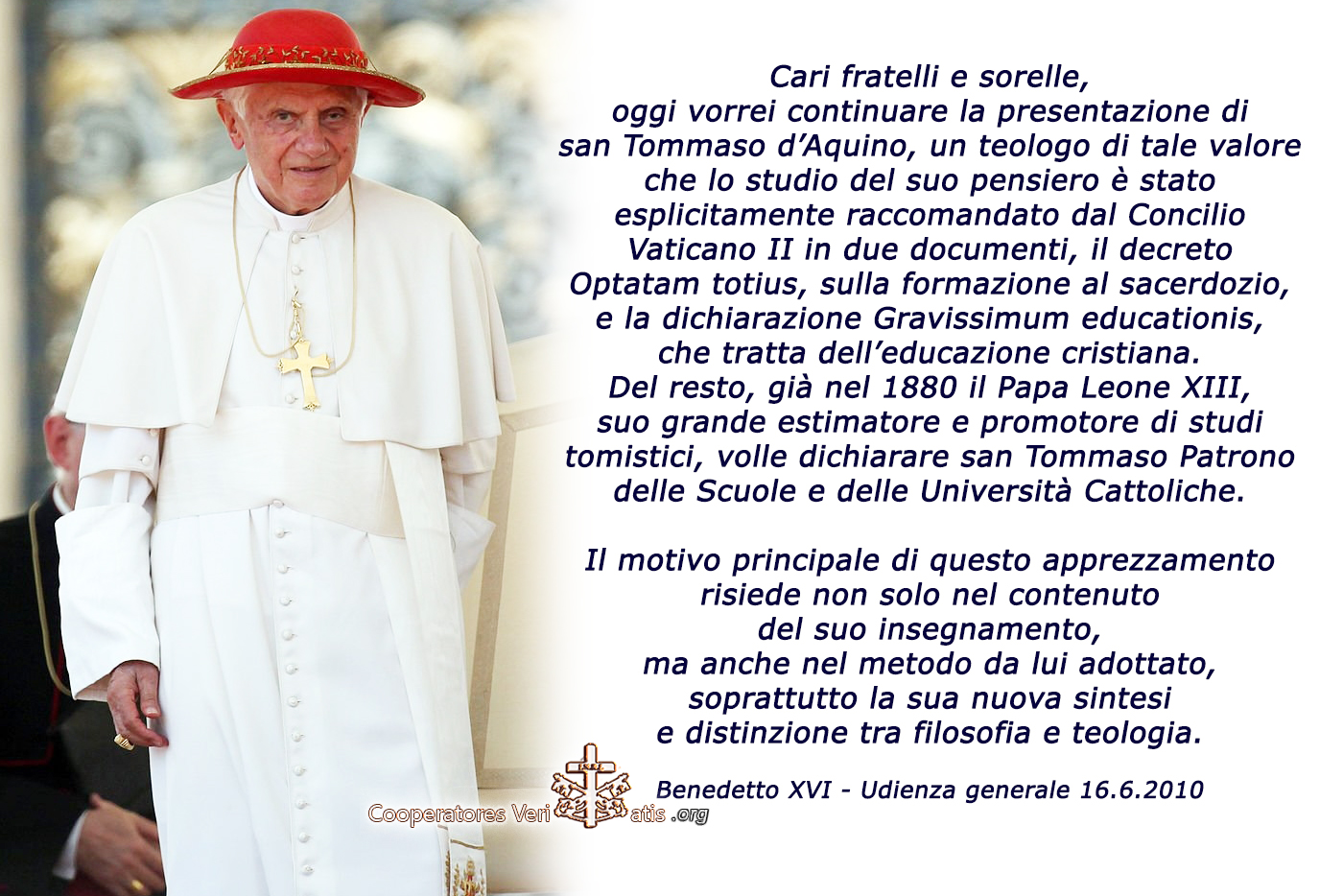
Newman, Doctor, Co-Patron of Catholic Education with Aquinas


Pope Leo XIII has decided to name Saint John Henry Newman a Co-Patron of Catholic Education, along side of Saint Thomas Aquinas, according to the statement by the Prefect of the Dicastery for Culture and Education, His Eminence José Cardinal Tolentino de Mendonça. The Holy Father will do that with the publication of a November 28th document on Catholic Education to commemorate the 60th anniversary of the 1965 Vatican II document Gravissimum Educationis.

Here are the relevant quotes.

"...[T]he Holy Father has decided to associate the Jubilee of Education with the figure of an extraordinary educator and great inspirer of the philosophy of education: Saint John Henry Newman. We know that he will be declared a Doctor of the Church in the celebration on 1 November, the closing Holy Mass of the Jubilee of the World of Education. But that is not all. In the document he will publish next Tuesday, Pope Leo XIV affirms that, in the context of this Jubilee, he will have the great joy of naming Saint John Henry Newman co-patron of the educational mission of the Church, together with Saint Thomas Aquinas."

"...Tuesday, 28 October, a document by Pope Leo XIV will be published, to commemorate the sixtieth anniversary of Gravissimum Educationis, and to reflect on the current relevance of the Conciliar Declaration and on the challenges that education has to face today, in particular for Catholic schools and universities. Indeed, as Pope Leo writes in the Document:

"“The Declaration Gravissimum Educationis has not lost its bite. Since its reception, a constellation of works and charisms has been born... a spiritual and pedagogical heritage capable of traversing the twenty-first century and responding to the most pressing challenges. This heritage is not set in stone: it is a compass that continues to point the way. Expectations today are no less than those the Church faced sixty years ago. On the contrary, they have expanded and become more complex... history challenges us with new urgency. Rapid and profound changes expose children, adolescents and young people to unprecedented fragility. It is not enough to preserve: we need to relaunch. I ask all educational institutions to inaugurate a season that speaks to the hearts of the new generations, recomposing knowledge and meaning, competence and responsibility, faith and life”."


Sunday, October 19, 2025

Why "Dilexi te" is At Least a Yellow Flag (English/Spanish)


Below please find a commentary on the October 4th Apostolic Exhortation Dilexi te by a fine Catholic blog I follow in Spanish, from Barcelona: Germinans Germinabit. The translation is a quick ChatGPT translation which I have not yet proofread. The Spanish original follows the English. Enjoy! And, what I say is, always be suspicious of those who speak too excessively about helping the poor, like Judas who complained about the adoration of Christ as an expensive waste of ointment because he was the treasurer and a thief. (Cf. Plinthos on the trident anti-Christ modern conspiracy). A quick perusal of the exhortation footnotes reveals its pro-Francis/anti-Benedict XVI bias, not one reference to that masterpiece of the Ratzinger legacy, Deus Caritas Est!, the fruit of the intellectual work of the greatest mind of our age! That in itself is, at best, a gross omission for many huge reasons, some of which are mentioned in the article below.

Cf., Philosophy Behind Papal Deus Caritas Est; also, Pope Benedict XVI's grand uncle's prize-winning book on the poor: The History of the Church's Relief for the Poor.

__

I must confess that I am very attentive to the words and actions of Leo XIV, because I have great hopes that he may be capable of setting the Church straight—after it accelerated its decline under his predecessor, a fall that began roughly a century ago (when Enlightenment ideas and the consequent French Revolution finally penetrated the Church).

I must also confess that, just as I read the encyclicals of Benedict XVI with interest and delight, I avoided reading those of Francis so as not to jeopardize my equanimity. And for the same reasons that I read Benedict XVI, I was very interested in reading the first magisterial document of Leo XIV, in the form of an “apostolic exhortation.” I was aware that, since it was presented as the last encyclical prepared by the previous pope, I might be in for a surprise. It was said that he never published it because it was still pending final touches and above all, a fully assumed placet—something his poor health ultimately made impossible.

And I must say that yes, I did read it, and I was indeed very surprised—quite unpleasantly. It bears the mark of Pope Francis from the title to the signature.

Still, even with that, I have not lost my hope or my sense of anticipation. I am aware of the difficult situation of the Church that Leo XIV must now navigate. I also understand that he is obliged not to disappoint too abruptly those who believe Francis, through strategic appointments, tied everything up neatly. And obviously, Leo XIV now has to deal with the Vatican entanglements left to him by Francis. From what we’re beginning to see, it seems the room for maneuver allowed to him by the imposing Vatican structure is indeed very limited. That is why Leo XIV resembles his predecessor so much.

Indeed, the reading of Dilexi te was as hard to digest for me as Fiducia supplicans was, though for different reasons. Right from the title, when I checked Revelation 6:10 and saw that those words had nothing to do with the theme of the apostolic exhortation, my heart sank. A first blow, right to the forehead. “Ego dilexi te quoniam servasti verbum patientiae meae”: “I loved you because you have kept the word of my patience” (pardon the strictly literal translation). And just four lines above: “servasti verbum meum et non negasti nomen meum”—“you kept my word and did not deny my name.” Nothing, absolutely nothing, to do with poverty or the poor.

And another serious problem: where in Latin it says dilexi te (something like “I chose you, had a preference for you”), the original Greek says egápēsa se—I loved you, with the sublime love of charity (agape, which the Church has always translated as “charity”). Benedict XVI made that very clear in his encyclical Deus caritas est. The dilexi te of Revelation does not originate from the poverty of the church in Philadelphia—that’s not the topic—but rather from the greater or lesser influence of Judaism in the early churches, which had not yet been resolved in favor of the Gentiles.

That Leo XIV, in adopting this encyclical project of Francis as a “heritage” and “making it his own,” should begin with this interpretative pirouette based on the title left by his predecessor (since, given the topic, no other interpretation was possible) left a bad taste in my mouth. Naturally, I went to Revelation 3:7–13, to the original texts, and I could find no way to make them say what Leo XIV claims they say in his presentation of Francis’s unfinished encyclical. A bad taste in my mouth because it reminds me of the twisted translations of the Jehovah’s Witnesses, who even in the New Testament make the name “Jehovah” appear frequently. And they claim it is a legitimate translation of the original names Theós (God) and Kýrios (Lord) used in the New Testament to refer to God.

From there, I felt pushed into a purely textual critique, setting aside the doctrinal issues. Because, indeed, as soon as Francis’s text begins, in the first chapter, we find the citation of Matthew 26:8–11—the episode of the woman who pours perfume on Jesus’s head, and who, seeing the disciples’ disapproval, is defended by Jesus who gives them the key: “the poor you will always have with you.” Francis twists the meaning of the text and ends up claiming that Jesus’s intention in those words was to make it clear that the poor are the most important thing—in fact, more important than Jesus himself and his Redemption.

From there, the interpretations continue with a level of creativity only comparable to that shown by the authors of the Bible of Father James Martin. From such seeds come such weeds. If the pope is entitled to twist the texts like this, then anyone who comes after him will feel entitled to make the Bible say whatever they please.

Continuing along this highly creative reading of Scripture, the exhortation Dilexi te moves immediately to the passage in which Matthew and Mark recount the episode of the scribe (grammatéus) or lawyer (nomikós) who asks Jesus which is the most important commandment. Jesus replies: “Hear, O Israel: The Lord our God is one Lord, and you shall love (agapēseis) the Lord your God with all your heart, and with all your soul, and with all your mind, and with all your strength. The second is this: you shall love your neighbor (plēsíon—the one closest to you) as yourself. There is no commandment greater than these. On these two commandments hang all the Law and the Prophets.” Yes, of course, the Vulgate translated agapēseis as diliges (which is the word Francis chose for his encyclical).

And, whether we like it or not, the second commandment (to love the one closest to you, the one in community with you) is upheld by the first. If the first falls, the second loses all its foundation and meaning. Without God, man doesn’t work. And we see that clearly. If you abandon God—just like in the earlier passage, if you abandon the God-Man—everything collapses. And that is where the enormous difference lies between the two encyclicals of Benedict XVI and Francis’s attempted encyclical. The two by Benedict are centered on the first commandment—the love of God; in Francis’s encyclical, endorsed by Leo XIV, God and theological reflection are pushed aside to give full prominence to man. In any case, in his second encyclical, Benedict XVI emphasized that Charity only makes sense if it does not stray from the Truth—Caritas in Veritate. Because we’re in trouble if we base it on lies, as the world tends to do.

And then comes the text of the burning bush, in which Francis has Yahweh say that what really concerns him is not the slavery of his people, but their poverty. And in the episodes of the Samaritan, the paralytic, the blind man… the problem is always poverty, and that’s what Jesus remedies in each case. Well, Your Holiness, the fact that all of them were poor does not mean that Jesus was dedicated—let alone primarily or exclusively—to alleviating their poverty. On the contrary, the narrative from Exodus in which the burning bush appears centers on the epic of the liberation of the people of Israel—not from poverty, but from something far worse: slavery, which, by the way, is the great threat we face today. No, it wasn’t poverty that moved God to care for humanity and commit to its redemption, but slavery. Not forgetting the slavery of sin, which ultimately leads to the worst loss of freedom. To the paralytic, he said: “Your sins are forgiven.” That was what mattered to Jesus, not his poverty.

Let this suffice for today; the strictly doctrinal issue remains to be addressed, which, si oportet, I shall take up in another article.__

He de confesar que estoy muy pendiente de las palabras y de las actuaciones de León XIV, porque tengo grandes esperanzas de que sea capaz de enderezar la Iglesia, que con su antecesor aceleró la caída en que se había precipitado desde hace aproximadamente un siglo (desde que penetraron definitivamente en la Iglesia las ideas de la Ilustración y la consiguiente revolución francesa).
He de confesar asimismo que, tal como me leí con afición y fruición las encíclicas de Benedicto XVI, evité leer las de Francisco por no poner en riesgo mi ecuanimidad. Y por las mismas razones que leí a Benedicto XVI, he tenido un gran interés en leer el primer documento magisterial de León XIV en forma de “exhortación apostólica”. Era consciente de que al ser presentada como la última encíclica que preparó el anterior pontífice, podía llevarme alguna sorpresa. Se dijo que no llegó a publicarla por quedar pendiente de los últimos retoques y sobre todo, de un placet totalmente asumido: cosa que, sin duda, hizo imposible la precariedad de su salud. Y he de decir que sí, que la he leído y me he llevado una gran sorpresa: muy desagradable. Lleva la marca del papa Francisco desde el título a la firma.
Pero aún con eso, no he perdido la ilusión y la esperanza. Soy consciente de lo difícil de la situación de la Iglesia con que ha de bregar León XIV. Consciente también de que se ve obligado a no desilusionar demasiado bruscamente a los que creen que Francisco, a base de nombramientos estratégicos, lo dejó todo atado y bien atado. Y, obviamente, a León XIV le toca bregar con las ataduras vaticanas que le ha dejado Francisco. Y, por lo que se va viendo, parece que el margen de maniobra que le deja la imponente estructura vaticana, es realmente escaso. Por eso, León XIV se parece tanto a su antecesor.

Pues sí, la lectura de Dilexi te, se me ha atragantado tanto como se me atragantó Fiducia supplicans, aunque por motivos distintos. Ya desde el título, al constatar en Apocalipsis 6,10 que esas palabras no tienen nada que ver con el tema de la Exhortación apostólica, se me cayó el alma a los pies. La primera, en la frente. ”Ego dilexi te quoniam servasti verbum patientiae meae”: Yo te amé porque conservaste la palabra de mi paciencia (perdón por la traducción rigurosamente literal). Y cuatro líneas más arriba, “servasti verbum meum et non negasti nomen meum: guardaste mi palabra y no negaste mi nombre”. Nada, abolutamente nada que ver con la pobreza y los pobres. Con otro grave inconveniente, y es que donde en latín dice “dilexi te” (que es algo así como “te elegí, tuve predilección por ti”, el original griego dice “egápesa se”, te amé, con el sublime amor de caridad (agape, lo ha traducido siempre la Iglesia como “caridad”). Benedicto XVI lo dejó bien claro en su encíclica Deus cáritas est. El “dilexi te” del apocalipsis no se origina en la pobreza de la iglesia de Filadelfia, no es ése el tema, sino que tiene como causa el mayor o menor judaísmo de las primeras iglesias, todavía sin resolver en favor de los gentiles.
Que León XIV, al asumir como “herencia” de Francisco este proyecto de encíclica y “hacerlo suyo”, empiece con esta pirueta interpretativa del título con que se la dejó su predecesor (siendo el tema el que es, tampoco cabía otra interpretación), me dejó mal sabor de boca. Naturalmente, fui a Apocalipsis 3,7-13, a los textos originales, y no vi manera de hacer decir a esos textos, lo que les hace decir León XIV en su presentación de la encíclica inacabada de Francisco. Mal sabor de boca, porque me recuerda los retorcimientos de las traducciones de los Testigos de Jehova, que hasta en el Nuevo Testamento hacen aparecer profusamente el nombre de Jehová. Y encima sostienen que se trata de una traducción legítima de los nombres originales Zeós (Deus) y Kyrios (Dóminus) con que se denomina a Dios en el Nuevo Testamento.
A partir de ahí, me vi empujado ya a la crítica meramente textual, sin detenerme en la doctrina. Porque, en efecto, nada más empezar el texto de Francisco, en el capítulo primero, aparece la cita de Mateo 26.8.9-11. El episodio de la mujer que vierte un frasco de perfume en la cabeza de Jesús; y que, al ver la desaprobación de los discípulos, les da la clave de la prioridad del homenaje a Dios, diciendo: “a los pobres los tendréis siempre con vosotros”. Francisco retuerce el sentido del texto, y acaba diciendo que la intención de Jesús en esas palabras, es dejar claro que los pobres son lo más importante; en realidad, más importantes que el mismo Jesús y su Redención.
Y a partir de ahí siguen las interpretaciones de una creatividad sólo comparable a la que han exhibido los autores de la Biblia del padre James Martin. De esos polvos, estos lodos. Si le está bien al papa retorcer los textos de esa manera, puede venir cualquiera detrás de él a hacerle decir a la Biblia cualquier cosa que le apetezca.
Y siguiendo en esa línea de lectura tan creativa de la Biblia, la exhortación Dilexi te pasa de inmediato al pasaje en que Mateo y Marcos narran lo del escriba (grammatéus) o leguleyo (nomikós) que le pregunta a Jesús cuál es el mandamiento más importante de todos, y Jesús le responde: “Escucha, Israel, el Señor Dios vuestro, es un solo Señor: y amarás (agapéseis) al Señor tu Dios desde todo tu corazón y desde toda tu alma y desde todo tu entendimiento y desde toda tu fuerza. El segundo es éste: amarás a tu prójimo (plesíon, próximo, el que tienes más cerca) como a ti mismo. No hay otro mandamiento superior a éste. En estos dos mandamientos pende toda la ley y los profetas. Sí, claro, la Vulgata tradujo el agapéseis por díliges (que es el término que eligió Francisco para su encíclica).


Y, mal que nos pese, el segundo mandamiento (el de amar al que tienes más cerca, que forma comunidad contigo) se sostiene sobre el primero. Si cae el primero, pierde toda sustentación y sentido el segundo. Sin Dios, el hombre no funciona. Bien que lo vemos. Si abandonas a Dios, igual que en el pasaje anterior, si abandonas al Dios-Hombre, todo se desmorona. Y es ahí donde radica la enorme diferencia entre las dos encíclicas de Benedicto XVI, y el intento de encíclica de Francisco. Las dos encíclicas del primero, están presididas por el primer mandamiento, el del amor de Dios; en la de Francisco, suscrita por León XIV, quedan arrinconados Dios y la reflexión teológica, para ceder todo el protagonismo al hombre. En todo caso, en su segunda encíclica, Benedicto XVI puntualizó que sólo tiene sentido la Caridad si no se aparta de la Verdad. Cáritas in Veritate. Porque mal andamos si la sostenemos en la mentira, como estila hacer el mundo.
Y luego vendrá el texto de la zarza ardiente, en el que Francisco le hace decir a Yahvé que lo que en realidad le preocupa no es la esclavitud de su pueblo, sino su pobreza. Y en el episodio del samaritano, del paralítico, del ciego… el problema es siempre la pobreza, y eso es a lo que Jesús pone remedio en cada caso. Pues oiga, Santidad, el hecho de que todos esos fuesen pobres, no indica que Jesús se dedicase ni prioritaria ni exclusivamente a remediar su pobreza. Más aún, la narración del Éxodo de la que cita la zarza ardiente, se centra en la epopeya de la liberación del pueblo de Israel: pero no de la pobreza, sino de algo muchísimo más grave, la esclavitud, que por cierto es la gran amenaza que hoy nos acosa. No, no es la pobreza la que movió a Dios a preocuparse del hombre, y empeñarse en su redención, sino la esclavitud. Sin olvidar la del pecado, que desemboca finalmente en la peor pérdida de la libertad. Al paralítico le dijo: tus pecados te son perdonados. Eso fue lo importante para Jesús, no su pobreza.
Baste esto por hoy; queda por abordar la estricta cuestión doctrinal, de la que, si oportet, me ocuparé en otro artículo.

Friday, October 17, 2025

WE ARE IN A RELIGIOUS WAR—A WAR OF FAITH


October 16, 2025

Clearly we cannot speak of wars whose sole motivation is religion, because in every war all kinds of motivations are involved. But history certainly offers us a good number of wars for which religion has been the primary pretext. In the war currently unfolding—with Gaza at its epicenter—the religious factor plays a decisive role. Starting with Israel, the most agnostic and immoral actor among those involved in this war. We cannot dismiss the possibility that the enormous arrogance with which they are acting is fueled by their belief in being the people chosen by God, who promised them—some 3,000 years ago—the land they are fighting for. And they make no effort to hide the fact that this is written in the Bible—not even the atheist Netanyahu, nor the other members of the government.

Let us not forget that almost since the very existence of the State of Israel, successive governments have been formed thanks to the most radical religious parties. These parties have not succeeded in instilling any degree of religiosity in either the government or civil society; yet they have earned a nearly superstitious respect that ensures Israel does not fall into the kind of absurd religious persecution we are experiencing in Spain and much of Europe—a persecution of the very religion that built Europe and runs in its veins, even as it is now being vehemently denied in practice. A persecution especially virulent against Catholicism.

We have three religious actors in conflict in the war in Gaza: Islam, Judaism, and Christianity in its Protestant form, represented by the United States, which is actually the main player. These are the three “Religions of the Book,” as Muslims say—a unique perspective that, in a certain way, makes them siblings in the eyes of Islam. Although it considers them “infidels,” it softens this label to the mildest degree. This has enabled, throughout history, various levels of understanding and dialogue amid often brutal wars.

Coming back to Gaza, it is not necessary to focus on who started each campaign of the war. It is better to focus on who has the power to end it today—precisely the one who has sustained it from the very beginning. As soon as the United States threatens to withdraw from the war, it extinguishes on its own, like a candle that has run out of wax, or an oil lamp that has no more oil. It is evident that this is an alliance between Christians (the U.S.) and Jews (Israel) against the Palestinians (Muslims). It is also evident that the U.S. and Israel have essentially acted as a single block, with the U.S. providing economic support, and Israel acting as the executing arm (with full operational military support from the U.S. when needed).

When we focus on the religious engine of this conflict, we see the major differentiating factor between the three religions at play. There is no doubt that Gaza, Palestine, and the Arab countries in general are deeply religious peoples, who tend toward forming theocracies (some already are) because they do not separate civic (political) duties from religious ones. For Muslims, all behavior must be inspired by the law of the Qur’an.

The first result of this is the disappearance of hypocrisy (and schizophrenia, in the best of cases), which occurs in countries governed by two sources of law and morality: public civil law on the political level, and religious law that is totally individual and private. These laws and norms often blatantly contradict one another, so that in the West—in Christian countries and in the only Jewish country—politics ends up prevailing, at the expense of religion, and therefore of morality. Muslim politicians, on the other hand, do not need to divide their loyalty between the Qur’an and a Constitution, since the latter cannot override the former. This allows them to be whole and consistent in their political identity.

As a result, civil society operates with much clearer ideas, and without the contradictions that lead to social paralysis, various degrees of immorality, and ultimately demoralization in the face of any struggle. That is why, from the outset, Muslim countries have much more battle-ready populations, much more willing to go to war to defend their way of life—that is, their faith and religion. Nothing like the enormous difficulties faced by Israel (where religious extremists refuse to take up arms!) or the United States, riddled with fentanyl addiction. And we won’t even mention Europe: in Ukraine, for example—an Orthodox Christian country—there are enormous difficulties in recruiting soldiers. The exodus of military-aged men is scandalous. Nor do the European countries, so eager to help Ukraine, have any clear idea of how to find soldiers. Because when it comes to creed, to morals and morality, the European citizenry has nothing to defend; and therefore, no one wants to go to war. It’s a different story for the politicians and leaders, who play in another league.

In the end, it won’t be religion, not even culture, that will move the European masses to mobilize for their own survival. As Muammar Gaddafi said: “We have 50 million Muslims in Europe. There are signs that Allah will grant Islam victory in Europe without swords, without guns, without conquest. Europe will become a Muslim continent within a few decades.”

And so, while Europeans entertain themselves by denying their soul, renouncing their roots, feeling ashamed of their history, and persecuting the last witnesses of the Christian faith that made them free, the peoples who still believe, who still pray, who still educate their children in divine law, march forward steadily toward the spiritual conquest of the continent. It will not be an invasion with tanks or missiles, but with cradles, mosques, and convictions. Because those who believe in nothing defend nothing. And those who defend nothing are doomed to be defeated.

Europe has ceased to be Christian not because the cross was taken from it, but because it voluntarily cast it to the ground. And now, as in the days of the invasions following the fall of the Roman Empire, the West is preparing to welcome its new rulers—not by force, but by abandonment. Islam is not conquering; it is occupying the void left by a civilization that has renounced itself. And while the shepherds remain silent, the politicians legislate against faith, against human nature itself, and the youth lose themselves in indulgence, the new Europeans pray five times a day, educate their children in the law of Allah, and prepare to inherit what we have scorned.

This is not a clash of civilizations, but an unconditional surrender. And when we awaken—if we awaken—it will be only to discover that we are no longer masters of our land, our customs, or our souls. Because while we were ashamed of Christ, others took pride in Allah and his prophet. While we demolished and sold churches, they built mosques. While we aborted our children, they received theirs with joy and raised them in the faith. And when we want to recover what we’ve lost, there will be nothing left to recover. Then it will be too late for regrets, too late for speeches, too late for reforms. Because history does not wait for the faint-hearted. And Europe, once the beacon of Christian civilization, will be swept away by the tide of its own apostasy. It will not be Islam’s fault, nor Gaddafi’s, nor the immigrants’. It will be our fault—for having betrayed God, for having renounced our faith, for having chosen pleasure over the cross, forgetfulness over memory, spiritual death over eternal life. We are indeed in a religious war—but above all, in a war of faith. And those who do not believe, do not fight. And those who do not fight, lose.
That simple. That tragic. That just.

Father Custodio Ballester Bielsa
www.sacerdotesporlavida.info

Wednesday, October 15, 2025

The False Francis Narrative: Catholic Tradition is Divisive


Exposing the Lie that Upholding Apostolic Tradition and Sound Doctrine Causes Division and Disunity

The obvious falsehood, often used against proponents of orthodoxy during Francis' pontificate, must go if Leo XIV's stated wish to end polarisation within the Church is to be achieved.

Now that some time has passed to calmly reflect on the Francis pontificate, one aspect urgently needing examination is the nature of the internal disunity, discord and disorder of those years.

In previous pontificates, polarisation and division were widely seen to have come from dissenters – modernist cardinals, bishops and theologians who promoted teaching that ran contrary to the Magisterium.

Popes up until Francis had corrected them, perhaps not as firmly or frequently as many would have liked, but it was always clear that the Holy Father, despite occasional questionable words or actions of his own, was the focus of unity, the custodian of sound doctrine, and that the dissenters were the protagonists of division.

But when Cardinal Bergoglio was elected, that all changed. Suddenly the dissenters were in charge as Francis quickly set about implementing the modernist revolution, unleashing great unrest and what many view as a diabolical disorientation within the institutional Church that has caused great harm to souls and the Church’s evangelical witness.

There are too many examples of this discord to mention, but Cardinal Walter Kasper’s 2014 proposal to allow, in some cases, civilly remarried divorcees to receive Holy Communion was arguably the touchpaper, igniting bitter internal and very public infighting that up until then I’d never witnessed in my time covering the Vatican.

The “Kasper Proposal” became, as many had predicted, a Trojan Horse. It led to Amoris Laetitia and the promotion of a so-called “paradigm shift” that ushered in other heterodox and heretical ideas, and sparked further acrimony and bitterness that lasted throughout Francis’ pontificate.

We can easily forget just how grave the situation was: seven filial corrections signed by bishops, priests, prominent laity and respected scholars; the famous five dubia from four cardinals followed by a second dubia eight years latera cardinal calling for a “profession of faith on the part of the Pope;” and a leading theologian warning of what he called an “internal papal schism.”

The Church Fathers and other great theologians of the past are clear about the origin of disunity in the Church. St Augustine of Hippo identified the deliberate rejection of established doctrine as a main source of schism and division. St Irenaeus of Lyons, in his writings against the Gnostics, argued that heresies fracture the Church’s unity by introducing teachings contrary to apostolic tradition. St Vincent of Lerins famously warned that the development of doctrine must never introduce novelty or create division within the Church, but instead grow organically in continuity with apostolic tradition. Then there is Pope Leo XIII who, in his 1899 apostolic letter Testem benevolentiae nostrae, listed specific modern heterodoxies at that time as heretical tendencies jeopardising Church unity.

And yet so often during those Francis years of revolution, and even now during the pontificate of Pope Leo, it is orthodox Catholics — often traditional but not exclusively so — who continue to be accused of being the ideologues, the dividers and the dissenters. All for simply holding the line and defending apostolic tradition in the face of a prevailing storm of heterodoxy and heresy.

To be sure, vocal and highly reactionary elements who aligned themselves with tradition exacerbated those divisions, as did social media. But for those with eyes to see, the chief cause was allowing ideologies alien to the Catholic Church and her Magisterium to be imposed on the faithful, thereby engendering discord, deepening polarisation, and increasing the chance of schism.

Pope Leo has stressed that his aim is to neutralise this polarisation. If he’s serious about this and wishes to bring internal Church peace and unity, then he might wish to consider its provenance and acknowledge the great lie and false projection of the past pontificate: that it was those who faithfully stood by the established teaching of the Church in the face of heterodoxy and dissent who were the principal divisive trouble-makers and even schismatics.

Nothing could be further from the truth.

Related Posts Plugin for WordPress, Blogger...