Tuesday, July 12, 2022

Sedes Sapientiae, The Patroness of College Education


Here is the original 13th century seal of the first university in history, The University of Paris.

It very prominently depicts Our Lady, the Most Blessed Virgin Mary crowned and enthroned in the center on high with Our Lord, the Eternal Wisdom, Jesus Christ, the Messiah, the Eternal Incarnate Word, enthroned also in her lap at her side.

SIGILLUM UNIVERSITATIS MAGISTRORUM ET SCOLARIUM PARISIUS

“[The University incorporates] the notion of becoming a professional intellectual, someone trained in a manner regulated by others who were trained in the same fashion.

“A consideration of visual images associated with the University and its nations provides a glimpse into how boundaries were circumscribed and how a flexible and emerging identity is made visually concrete.” In the adoption of its own corporate seal the University manifests its desire and right to act autonomously.

This is an image of the corporate seal of The University of Paris from the oldest extant copy of that seal, which is attached to a document from 1292. The seal is a guarantee that the document belongs to the collective body of the University. “[It] portrays a range of figures enclosed within an architectural framework that is distinctly Parisian in style and evocative of Notre-Dame cathedral. The Virgin and Child are seated in the largest uppermost niche. Flanking them are Saint Catherine [of Alexandria, c. 287- c. 305], one of the major patron saints of scholars, on the right, and a bishop in profile on the left. Below them are six compartments with figures of students and masters lecturing, disputing and reading. In the twelfth century, Peter the Chanter named reading, disputation, and preaching as the three requirements of the master of theology. He describes them as fundamental parts of a building: ‘The practice of Bible study consists in three things: reading [/"lecturing"] (lectione), disputation, preaching...Reading is, as it were, the foundation and basement for what follows, for through it the rest is achieved. Disputation is the wall in the building of study, for nothing is fully understood or faithfully preached, if it is not first chewed by the tooth of disputation. Preaching, which is supported by the former, is the roof, sheltering the faithful from the heat and wind of temptation.’ (Peter the Chanter, Verbum abbreviatum, PL 205, c. 25, trans. In B. Smalley, The Study of the Bible in the Middle Ages, 2nd ed rev. [Oxford, 1952], p. 208)

“...The University of Paris first used a corporate seal from 1221 to 1225...[It was] Pope Innocent IV who, while renewing several scholarly privileges in 1246, gave the masters permission to use their own seal...[Without] a corporate seal, the University would have had to appeal to the Chapter of Notre-Dame to have their documents sealed, not a very desirable practice when trying to get around about the bishop.

“Smaller subgroups within the University, such as its nations, also asserted their own corporate identities in images.”

Charlotte Bauer, “Picturing and Promoting New Identities: The Medieval University at Paris and its ‘Nations’” in Mobs, van Deusen and Koff editors, Brill: Leiden, Netherlands, 2012, 120-122.

Our Lady of Mount Carmel, Newark


(973) 589-2090

Tuesday, July 5, 2022

The Eternal Instinct by Dr. John W. Neumayr, RIP

Dr. John W. Neumayr, one of the founders of Thomas Aquinas College, died yesterday. May Christ grant him the glorious reward of heaven in the company of the Most Blessed Virgin Mary and all the angels and saints. Requiscat in pace!


Dobbs VS Jackson: Excerpts of New Abortion Law


Dobbs VS Jackson, Friday, June 24, 2022, The Most Sacred Heart of Jesus

Roe’s defenders characterize the abortion right as similar to the rights recognized in past decisions involving matters such as intimate sexual relations, contraception, and marriage, but abortion is fundamentally different, as both Roe and Casey acknowledged, because it destroys what those decisions called “fetal life” and what the law now before us describes as an “unborn human being.”13 Stare decisis, the doctrine on which Casey’s controlling opinion was based, does not compel unending adherence to Roe’s abuse of judicial authority...

Roe was egregiously wrong from the start. Its reasoning was exceptionally weak, and the decision has had damaging consequences. And far from bringing about a national settlement of the abortion issue, Roe and Casey have enflamed debate and deepened division. It is time to heed the Constitution and return the issue of abortion to the people’s elected representatives. “The permissibility of abortion, and the limitations, upon it, are to be resolved like most important questions in our democracy: by citizens trying to persuade one another and then voting.” Casey, 505 U. S., at 979 (Scalia, J., concurring in judgment in part and dissenting in part). That is what the Constitution and the rule of law demand...

The law at issue in this case, Mississippi’s Gestational Age Act, see Miss. Code Ann. §41–41–191 (2018), contains this central provision: “Except in a medical emergency or in the case of a severe fetal abnormality, a person shall not intentionally or knowingly perform . . . or induce an abortion of an unborn human being if the probable gestational age of the unborn human being has been determined to be greater than fifteen (15) weeks.” §4(b). (The Act defines “gestational age” to be “the age of an unborn human being as calculated from the first day of the last menstrual period of the pregnant woman.”)...

To support this Act, the legislature made a series of factual findings. It began by noting that, at the time of enactment, only six countries besides the United States “permit[ted] nontherapeutic or elective abortion-on-demand after the twentieth week of gestation.”15 §2(a). (Those other six countries were Canada, China, the Netherlands, North Korea, Singapore, and Vietnam.) The legislature then found that at 5 or 6 weeks’ gestational age an “unborn human being’s heart begins beating”; at 8 weeks the “unborn human being begins to move about in the womb”; at 9 weeks “all basic physiological functions are present”; at 10 weeks “vital organs begin to function,” and “[h]air, fingernails, and toenails . . . begin to form”; at 11 weeks “an unborn human being’s diaphragm is developing,” and he or she may “move about freely in the womb”; and at 12 weeks the “unborn human being” has “taken on ‘the human form’ in all relevant respects.” §2(b)(i) (quoting Gonzales v. Carhart, 550 U. S. 124, 160 (2007)). It found that most abortions after 15 weeks employ “dilation and evacuation procedures which involve the use of surgical instruments to crush and tear the unborn child,” and it concluded that the “intentional commitment of such acts for nontherapeutic or elective reasons is a barbaric practice, dangerous for the maternal patient, and demeaning to the medical profession.” 5-7

...in Glucksberg, which held that the Due Process Clause does not confer a right to assisted suicide, the Court surveyed more than 700 years of “Anglo-American common law tradition,” 521 U. S., at 711, and made clear that a fundamental right must be “objectively, deeply rooted in this Nation’s history and tradition,” id., at 720–721. Historical inquiries of this nature are essential whenever we are asked to recognize a new component of the “liberty” protected by the Due Process Clause because the term “liberty” alone provides little guidance. “Liberty” is a capacious term. As Lincoln once said: “We all declare for Liberty; but in using the same word we do not all mean the same thing.”20 In a well-known essay, Isaiah Berlin reported that “[h]istorians of ideas” had cataloged more than 200 different senses in which the term had been used. In interpreting what is meant by the Fourteenth Amendment’s reference to “liberty,” we must guard against the natural human tendency to confuse what that Amendment protects with our own ardent views about the liberty that Americans should enjoy. That is why the Court has long been “reluctant” to recognize rights that are not mentioned in the Constitution. 12-13

Instead of seriously pressing the argument that the abortion right itself has deep roots, supporters of Roe and Casey contend that the abortion right is an integral part of a broader entrenched right. Roe termed this a right to privacy, 410 U. S., at 154, and Casey described it as the freedom to make “intimate and personal choices” that are “central to personal dignity and autonomy,” 505 U. S., at 851. Casey elaborated: “At the heart of liberty is the right to define one’s own concept of existence, of meaning, of the universe, and of the mystery of human life.” Ibid. The Court did not claim that this broadly framed right is absolute, and no such claim would be plausible. While individuals are certainly free to think and to say what they wish about “existence,” “meaning,” the “universe,” and “the mystery of human life,” they are not always free to act in accordance with those thoughts. License to act on the basis of such beliefs may correspond to one of the many understandings of “liberty,” but it is certainly not “ordered liberty.” Ordered liberty sets limits and defines the boundary between competing interests. Roe and Casey each struck a particular balance between the interests of a woman who wants an abortion and the interests of what they termed “potential life.” Roe, 410 U. S., at 150 (emphasis deleted); Casey, 505 U. S., at 852. But the people of the various States may evaluate those interests differently. In some States, voters may believe that the abortion right should be even more extensive than the right that Roe and Casey recognized. Voters in other States may wish to impose tight restrictions based on their belief that abortion destroys an “unborn human being.” Miss. Code Ann. §41–41–191(4)(b). Our Nation’s historical understanding of ordered liberty does not prevent the people’s elected representatives from deciding how abortion should be regulated. 30-31

These attempts to justify abortion through appeals to a broader right to autonomy and to define one’s “concept of existence” prove too much. Casey, 505 U. S., at 851. Those criteria, at a high level of generality, could license fundamental rights to illicit drug use, prostitution, and the like. See Compassion in Dying v. Washington, 85 F. 3d 1440, 1444 (CA9 1996) (O’Scannlain, J., dissenting from denial of rehearing en banc). None of these rights has any claim to being deeply rooted in history. Id., at 1440, 1445. What sharply distinguishes the abortion right from the rights recognized in the cases on which Roe and Casey rely is something that both those decisions acknowledged: Abortion destroys what those decisions call “potential life” and what the law at issue in this case regards as the life of an “unborn human being.” See Roe, 410 U. S., at 159 (abortion is “inherently different”); Casey, 505 U. S., at 852 (abortion is “a unique act”). None of the other decisions cited by Roe and Casey involved the critical moral question posed by abortion. They are therefore inapposite. They do not support the right to obtain an abortion, and by the same token, our conclusion that the Constitution does not confer such a right does not undermine them in any way. 32

The largely limitless reach of the dissenters’ standard is illustrated by the way they apply it here. First, if the “long sweep of history” imposes any restraint on the recognition of unenumerated rights, then Roe was surely wrong, since abortion was never allowed (except to save the life of the mother) in a majority of States for over 100 years before that decision was handed down. Second, it is impossible to defend Roe based on prior precedent because all of the precedents Roe cited, including Griswold and Eisenstadt, were critically different for a reason that we have explained: None of those cases involved the destruction of what Roe called “potential life.” See supra, at 32. So without support in history or relevant precedent, Roe’s reasoning cannot be defended even under the dissent’s proposed test, and the dissent is forced to rely solely on the fact that a constitutional right to abortion was recognized in Roe and later decisions that accepted Roe’s interpretation. Under the doctrine of stare decisis, those precedents are entitled to careful and respectful consideration, and we engage in that analysis below. But as the Court has reiterated time and time again, adherence to precedent is not “‘an inexorable command.’” Kimble v. Marvel Entertainment, LLC, 576 U. S. 446, 455 (2015). There are occasions when past decisions should be overruled, and as we will explain, this is one of them. 37

The most striking feature of the dissent is the absence of any serious discussion of the legitimacy of the States’ interest in protecting fetal life. This is evident in the analogy that the dissent draws between the abortion right and the rights recognized in Griswold (contraception), Eisenstadt (same), Lawrence (sexual conduct with member of the same sex), and Obergefell (same-sex marriage). Perhaps this is designed to stoke unfounded fear that our decision will imperil those other rights, but the dissent’s analogy is objectionable for a more important reason: what it reveals about the dissent’s views on the protection of what Roe called “potential life.” The exercise of the rights at issue in Griswold, Eisenstadt, Lawrence, and Obergefell does not destroy a “potential life,” but an abortion has that effect. So if the rights at issue in those cases are fundamentally the same as the right recognized in Roe and Casey, the implication is clear: The Constitution does not permit the States to regard the destruction of a “potential life” as a matter of any significance. That view is evident throughout the dissent. The dissent has much to say about the effects of pregnancy on women, the burdens of motherhood, and the difficulties faced by poor women. These are important concerns. However, the dissent evinces no similar regard for a State’s interest in protecting prenatal life. The exercise of the rights at issue in Griswold, Eisenstadt, Lawrence, and Obergefell does not destroy a “potential life,” but an abortion has that effect. So if the rights at issue in those cases are fundamentally the same as the right recognized in Roe and Casey, the implication is clear: The Constitution does not permit the States to regard the destruction of a “potential life” as a matter of any significance. That view is evident throughout the dissent. The dissent has much to say about the effects of pregnancy on women, the burdens of motherhood, and the difficulties faced by poor women. These are important concerns. However, the dissent evinces no similar regard for a State’s interest in protecting prenatal life. The dissent repeatedly praises the “balance,” post, at 2, 6, 8, 10, 12, that the viability line strikes between a woman’s liberty interest and the State’s interest in prenatal life. But for reasons we discuss later, see infra, at 50–54, 55–56, and given in the opinion of THE CHIEF JUSTICE, post, at 2–5 (opinion concurring in judgment), the viability line makes no sense. It was not adequately justified in Roe, and the dissent does not even try to defend it today. Nor does it identify any other point in a pregnancy after which a State is permitted to prohibit the destruction of a fetus. Our opinion is not based on any view about if and when prenatal life is entitled to any of the rights enjoyed after birth. The dissent, by contrast, would impose on the people a particular theory about when the rights of personhood begin. According to the dissent, the Constitution requires the States to regard a fetus as lacking even the most basic human right—to live—at least until an arbitrary point in a pregnancy has passed. Nothing in the Constitution or in our Nation’s legal traditions authorizes the Court to adopt that “‘theory of life.’” Post, at 8. 37-39

Roe was on a collision course with the Constitution from the day it was decided, Casey perpetuated its errors, and those errors do not concern some arcane corner of the law of little importance to the American people. Rather, wielding nothing but “raw judicial power,” Roe, 410 U. S., at 222 (White, J., dissenting), the Court usurped the power to address a question of profound moral and social importance that the Constitution unequivocally leaves for the people. Casey described itself as calling both sides of the national controversy to resolve their debate, but in doing so, Casey necessarily declared a winning side. Those on the losing side—those who sought to advance the State’s interest in fetal life—could no longer seek to persuade their elected representatives to adopt policies consistent with their views. The Court short-circuited the democratic process by closing it to the large number of Americans who dissented in any respect from Roe. “Roe fanned into life an issue that has inflamed our national politics in general, and has obscured with its smoke the selection of Justices to this Court in particular, ever since.” Casey, 505 U. S., at 995–996 (opinion of Scalia, J.). Together, Roe and Casey represent an error that cannot be allowed to stand. 44

In Part II, supra, we explained why Roe was incorrectly decided, but that decision was more than just wrong. It stood on exceptionally weak grounds. Roe found that the Constitution implicitly conferred a right to obtain an abortion, but it failed to ground its decision in text, history, or precedent. It relied on an erroneous historical narrative; it devoted great attention to and presumably relied on matters that have no bearing on the meaning of the Constitution; it disregarded the fundamental difference between the precedents on which it relied and the question before the Court; it concocted an elaborate set of rules, with different restrictions for each trimester of pregnancy, but it did not explain how this veritable code could be teased out of anything in the Constitution, the history of abortion laws, prior precedent, or any other cited source; and its most important rule (that States cannot protect fetal life prior to “viability”) was never raised by any party and has never been plausibly explained. Roe’s reasoning quickly drew scathing scholarly criticism, even from supporters of broad access to abortion. The Casey plurality, while reaffirming Roe’s central holding, pointedly refrained from endorsing most of its reasoning. It revised the textual basis for the abortion right, silently abandoned Roe’s erroneous historical narrative, and jettisoned the trimester framework. But it replaced that scheme with an arbitrary “undue burden” test and relied on an exceptional version of stare decisis that, as explained below, this Court had never before applied and has never invoked since.

The weaknesses in Roe’s reasoning are well-known. Without any grounding in the constitutional text, history, or precedent, it imposed on the entire country a detailed set of rules much like those that one might expect to find in a statute or regulation. See 410 U. S., at 163–164. Dividing pregnancy into three trimesters, the Court imposed special rules for each. During the first trimester, the Court announced, “the abortion decision and its effectuation must be left to the medical judgment of the pregnant woman’s attending physician.” Id., at 164. After that point, a State’s interest in regulating abortion for the sake of a woman’s health became compelling, and accordingly, a State could “regulate the abortion procedure in ways that are reasonably related to maternal health.” Ibid. Finally, in “the stage subsequent to viability,” which in 1973 roughly coincided with the beginning of the third trimester, the State’s interest in “the potentiality of human life” became compelling, and therefore a State could “regulate, and even proscribe, abortion except where it is necessary, in appropriate medical judgment, for the preservation of the life or health of the mother.” Id., at 164–165. This elaborate scheme was the Court’s own brainchild. Neither party advocated the trimester framework; nor did either party or any amicus argue that “viability” should mark the point at which the scope of the abortion right and a State’s regulatory authority should be substantially transformed. See Brief for Appellant and Brief for Appellee in Roe v. Wade, O. T. 1972, No. 70–18; see also C. Forsythe, Abuse of Discretion: The Inside Story of Roe v. Wade 127, 141 (2012). Not only did this scheme resemble the work of a legislature, but the Court made little effort to explain how these rules could be deduced from any of the sources on which constitutional decisions are usually based. . We have already discussed Roe’s treatment of constitutional text, and the opinion failed to show that history, precedent, or any other cited source supported its scheme. Roe featured a lengthy survey of history, but much of its discussion was irrelevant, and the Court made no effort to explain why it was included. 45-47

An even more glaring deficiency was Roe’s failure to justify the critical distinction it drew between pre- and postviability abortions. Here is the Court’s entire explanation: “With respect to the State’s important and legitimate interest in potential life, the ‘compelling’ point is at viability. This is so because the fetus then presumably has the capability of meaningful life outside the womb.” 410 U. S., at 163. As Professor Laurence Tribe has written, “[c]learly, this mistakes ‘a definition for a syllogism.’” Tribe 4 (quoting Ely 924). The definition of a “viable” fetus is one that is capable of surviving outside the womb, but why is this the point at which the State’s interest becomes compelling?...This arbitrary line has not found much support among philosophers and ethicists who have attempted to justify a right to abortion. Some have argued that a fetus should not be entitled to legal protection until it acquires the characteristics that they regard as defining what it means to be a “person.” Among the characteristics that have been offered as essential attributes of “personhood” are sentience, selfawareness, the ability to reason, or some combination thereof. By this logic, it would be an open question whether even born individuals, including young children or those afflicted with certain developmental or medical conditions, merit protection as “persons.” But even if one takes the view that “personhood” begins when a certain attribute or combination of attributes is acquired, it is very hard to see why viability should mark the point where “personhood” begins. The most obvious problem with any such argument is that viability is heavily dependent on factors that have nothing to do with the characteristics of a fetus. 50-51

Justice White complained that the Court was engaging in “unrestrained imposition of its own extraconstitutional value preferences.” Thornburgh, 476 U. S., at 794 (dissenting opinion). And the United States as amicus curiae asked the Court to overrule Roe five times in the decade before Casey, see 505 U. S., at 844 (joint opinion), and then asked the Court to overrule it once more in Casey itself.

When Casey revisited Roe almost 20 years later, very little of Roe’s reasoning was defended or preserved. The Court abandoned any reliance on a privacy right and instead grounded the abortion right entirely on the Fourteenth Amendment’s Due Process Clause. 505 U. S., at 846. The Court did not reaffirm Roe’s erroneous account of abortion history. In fact, none of the Justices in the majority said anything about the history of the abortion right. And as for precedent, the Court relied on essentially the same body of cases that Roe had cited. Thus, with respect to the standard grounds for constitutional decisionmaking—text, history, and precedent—Casey did not attempt to bolster Roe’s reasoning. The Court also made no real effort to remedy one of the greatest weaknesses in Roe’s analysis: its much-criticized discussion of viability. 55

Neither decision [Roe nor Casey] has ended debate over the issue of a constitutional right to obtain an abortion. Indeed, in this case, 26 States expressly ask us to overrule Roe and Casey and to return the issue of abortion to the people and their elected representatives. This Court’s inability to end debate on the issue should not have been surprising. This Court cannot bring about the permanent resolution of a rancorous national controversy simply by dictating a settlement and telling the people to move on. Whatever influence the Court may have on public attitudes must stem from the strength of our opinions, not an attempt to exercise “raw judicial power.” Roe, 410 U. S., at 222 (White, J., dissenting). We do not pretend to know how our political system or society will respond to today’s decision overruling Roe and Casey. And even if we could foresee what will happen, we would have no authority to let that knowledge influence our decision. We can only do our job, which is to interpret the law, apply longstanding principles of stare decisis, and decide this case accordingly. We therefore hold that the Constitution does not confer a right to abortion. Roe and Casey must be overruled, and the authority to regulate abortion must be returned to the people and their elected representatives. 68-69

Precedents should be respected, but sometimes the Court errs, and occasionally the Court issues an important decision that is egregiously wrong. When that happens, stare decisis is not a straitjacket. And indeed, the dissent eventually admits that a decision could “be overruled just because it is terribly wrong,” though the dissent does not explain when that would be so. Post, at 45. 70

Under our precedents, rational-basis review is the appropriate standard for such challenges. As we have explained, procuring an abortion is not a fundamental constitutional right because such a right has no basis in the Constitution’s text or in our Nation’s history. See supra, at 8–39.

It follows that the States may regulate abortion for legitimate reasons, and when such regulations are challenged under the Constitution, courts cannot “substitute their social and economic beliefs for the judgment of legislative bodies.”...A law regulating abortion, like other health and welfare laws, is entitled to a “strong presumption of validity.” Heller v. Doe, 509 U. S. 312, 319 (1993). It must be sustained if there is a rational basis on which the legislature could have thought that it would serve legitimate state interests. 77

These legitimate interests include respect for and preservation of prenatal life at all stages of development, Gonzales, 550 U. S., at 157–158; the protection of maternal health and safety; the elimination of particularly gruesome or barbaric medical procedures; the preservation of the integrity of the medical profession; the mitigation of fetal pain; and the prevention of discrimination on the basis of race, sex, or disability. . See id., at 156– 157; Roe, 410 U. S., at 150; cf. Glucksberg, 521 U. S., at 728– 731 (identifying similar interests).

These legitimate interests justify Mississippi’s Gestational Age Act. Except “in a medical emergency or in the case of a severe fetal abnormality,” the statute prohibits abortion “if the probable gestational age of the unborn human being has been determined to be greater than fifteen (15) weeks.” Miss. Code Ann. §41–41–191(4)(b). The Mississippi Legislature’s findings recount the stages of “human prenatal development” and assert the State’s interest in “protecting the life of the unborn.” §2(b)(i). The legislature also found that abortions performed after 15 weeks typically use the dilation and evacuation procedure, and the legislature found the use of this procedure “for nontherapeutic or elective reasons [to be] a barbaric practice, dangerous for the maternal patient, and demeaning to the medical profession.” §2(b)(i)(8); see also Gonzales, 550 U. S., at 135–143 (describing such procedures). These legitimate interests provide a rational basis for the Gestational Age Act, and it follows that respondents’ constitutional challenge must fail. 

We end this opinion where we began. Abortion presents a profound moral question. The Constitution does not prohibit the citizens of each State from regulating or prohibiting abortion. Roe and Casey arrogated that authority. We now overrule those decisions and return that authority to the people and their elected representatives. The judgment of the Fifth Circuit is reversed, and the case is remanded for further proceedings consistent with this opinion. It is so ordered. 78-79

Monday, July 4, 2022

Desiderio desideravi: Plinthos commentary


My first reaction, as with numerous other Pope Francis Papal pronouncements, is, Where is the official Latin text to be found? As of this morning, the Vatican web page of that June 29th, 2022 Apostolic Letter does not provide the Latin typical edition. How is one to know which text is the reference point among the five translations provided?

The sections most relevant to traditional Catholics are nos. 31 and 61.

In 31 Pope Francis erroneously equates Sacrosanctum concilium’s call with the Novus ordo (the Ordinary Form [OF]) of the Roman Rite, which, in fact, was not produced directly by Vatican II but by the "Consilium for the reform of the liturgical books," the liturgical commission set up by Pope Paul VI after the Council and headed by Annibale Bugnini. In saying the OF is the unique expression of the Roman Rite, he asserts a non-fact. Even the Missal of 1570 was never the unique expression of the Roman Rite.

But I concur when he says the problem is “ecclesiological.” The question of liturgical discipline is an important matter for the good of the Church.

In 61 He argues that the approval of Paul VI and of John Paul II is the guarantee of the Novus ordo's conformity with Vat II. “We cannot go back.” And he intends to reestablish “unity.” Here is another error, because the Ordinary Form of the Roman Rite is not a unitary form of the Roman Rite, notice, for instance, the Neo-Catechumenate form of worship as compared to a Mass of the Charismatic Renewal, and compare that to a papal OF Mass ad orientem, in Latin. "We cannot go back," if it has any meaning, must mean that we cannot delete the reform of the reform by Pope Benedict XVI.

The vague directives of the Novus ordo necessitate a wide variety of liturgical expressions, which results in very significant manifest differences from place to place. Acknowledging that problem of disunity in the liturgy is what compelled the Holy Father Pope Francis to publish Desiderio desideravi, to urge uniformity in the celebration of the Novus ordo!, having already summarily declared that the Extraordinary Form does not even exist. He treats this in nos. 48-62 (Ars celebrandi).

Pope Francis and most of the Novus ordo world continues to ignore and neglect the greatest fruit of the great liturgical reform of the past two centuries, as commissioned by the Vatican, to the monks of Solemnes over a century ago, the fruit of which is The Roman Gradual and the Liber Usualis. The great revival of Gregorian Chant and Polyphony today (e.g. Musica Sacra) is, by far, the best fruit of the modern reform (and the reform of the reform) of the Liturgy! It is hard to understand what the Holy Father means in this document when he speaks of "the reform" in a monolithic sense apparently unaware that the initial liturgical revolutionaries (i.e. Bugnini and all those who reject Sacrosanctum concilium's insistence on the maintaining of the Latin language as normative in the Roman Liturgy and of Gregorian chant and polyphony having pride of place in liturgical music and reiterated in GIRM, 41, 61) have already been superseded by an ever young and enormous wave of new reformers. The reformed liturgy has already been reformed. Pope Francis seems to be advocating for something which already happened, viz., the proper interpretation of the liturgy which was carried out by his immediate predecessor. It seems Pope Francis never read Ratzinger/Benedict XVI on the proper liturgical reform, e.g. The Spirit of the Liturgy.

This type of isolation in time is typical of the Argentinian psyche. When I visited Argentina 15 years ago it seemed to me that the Argentinians, with their pro-communism and pro-freudianism, were stuck somewhere in the 60's with ideas which the West had tried and rejected.

What the Holy Father seems to be doing liturgically is groping for answers which have already been given definitively by his predecessors, ignoring their enormous contributions. After the papacy of Pope Benedict XVI you cannot speak of the liturgical changes of Vatican II without any reference to his temendous work and insights. Pope Francis claims to speak with "precision" but, in fact, because of his neglect of the "reform of the reform" and "the hermeneutic of continuity" he is actually making what was clear vague.

Desiderio desideravi claims to be a longing for unity. The Holy Father must know that any Catholic "unity" worthy of the name is unity in the fullness of the truth we have received, the Deposit of Faith: cherishing, defending and promoting the same faith/morals/sacramental life in Christ, of every Age.

Tuesday, June 28, 2022

Secular Magnanimity: A Perfect Christian Virtue

Thus the title I would give to the great Jordan Peterson 2022 Hillsdale College Commencement Address below.


In life, "you aim up or down." Aim up!

View also the witty Peter Kreeft Stubenville Address, a broad critique of the stereotypical positive-thinking/self-help psychology graduation speech.

Monday, June 27, 2022

Pro-Life Victory on Jesus' Feast Day

Friday, June 24th (the Birthday of Saint John the Baptist), The Feast of the Sacred Heart of Jesus, less than a year before the 50th anniversary of the January 22nd, 1973 Supreme Court decision legalizing abortion Roe VS. Wade, Dobbs VS. Jackson overturns that decision. Here is the new law, unabridged, which is worth reading.

The United States of America now needs to enact an additional law defending every unborn human being, from the moment of conception, acknowledging the natural right to life by enshrining it in law. The child in the womb has the same God-given right to life as any other man that is born. That right is enshrined in The Declaration of Independence of the United States of America, "We hold these truths to be self-evident, that all men are created equal, that they are endowed by their Creator with certain unalienable Rights, that among these are Life, Liberty and the pursuit of Happiness." Every man in the womb must therefore be defended by the law of the land. Procured abortion, the direct and deliberate killing of an unborn human being, is against the law which forbids homicide. Of course, an anti-abortion would necessarily extend also to prohibit all abortifacient contraceptives.

"The health of the mother" should provide no exception to this law, because any pathology of the mother must be treated with equal consideration for the life of the unborn man, while maintaining the integrity of the principle of double effect and, therefore, not directly or deliberately harming the child.

All men of good will must demand the complete outlawing of abortion. Every unborn man has a right to be defended by the law.

Sunday, June 26, 2022

Chaste Relations = Marital Magnanimity


There was a lecture on magnanimity during the last day of the Sacra Doctrina Project 2022 Annual Conference in which the speaker referred to the frequently overlooked passage of Humanae Vitae, 21.

In the context of Natural Family Planning's periodic continence, the Encyclical indicates the magnanimous nature of marital chastity. This passage should preached by priests to highlight the sanctity of marital love because it emphasizes the human excellence, grandeur and superlative achievement of marital magnanimity, which is expressed and fostered by marital chastity, in the wholesome integrity of holy marital relations.

Here is the relevant quote from the encyclical.


Value of Self-Discipline

The right and lawful ordering of birth demands, first of all, that spouses fully recognize and value the true blessings of family life and that they acquire complete mastery over themselves and their emotions. For if with the aid of reason and of free will they are to control their natural drives, there can be no doubt at all of the need for self-denial. Only then will the expression of love, essential to married life, conform to right order. This is especially clear in the practice of periodic continence. Self-discipline of this kind is a shining witness to the chastity of husband and wife and, far from being a hindrance to their love of one another, transforms it by giving it a more truly human character. And if this self-discipline does demand that they persevere in their purpose and efforts, it has at the same time the salutary effect of enabling husband and wife to develop to their personalities and to be enriched with spiritual blessings. For it brings to family life abundant fruits of tranquility and peace. It helps in solving difficulties of other kinds. It fosters in husband and wife thoughtfulness and loving consideration for one another. It helps them to repel inordinate self-love, which is the opposite of charity. It arouses in them a consciousness of their responsibilities. And finally, it confers upon parents a deeper and more effective influence in the education of their children. As their children grow up, they develop a right sense of values and achieve a serene and harmonious use of their mental and physical powers. Humanae Vitae, 21.

Wednesday, June 15, 2022

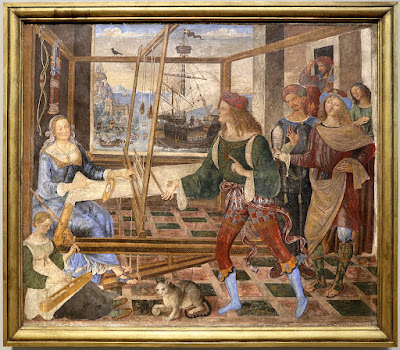
Marital Fidelity in the Odyssey


"The Trunk of the Olive Tree": The 'Testing of the Bed' As a Symbol of Fidelity and Like-mindedness in Homer's The Odyssey by Erin Whittemore
The old nurse went upstairs exulting. to tell the mistress of her lord's return, and cried out by the lady's pillow: "Wake, wake up, dear child! Penelope, come down, see with your own eyes what all these years you longed for! Odysseus is here! Oh, in the end, he came! And he has killed your suitors, killed them all Penelope said: "I am stunned, I cannot speak to him. I cannot question him. I cannot keep my eyes upon his face. If really he is Odysseus, truly home, beyond all doubt we two shall know each other better than you or anyone. There are secret signs we know, we two." Homer's The Odyssey, Book 23 (lines 1-10, 119-125)
A 20-year separation would be enough to force even the most loving, well-matched couple into experiencing feelings of doubt and struggle- even the hero and heroine of Homer's epic, The Odyssey. Odysseus, though he longs solely for home and wife, is plagued with uncertainty after hearing the stories of the adulteresses, Klytaimnestra and Helen, and the warnings of Agamemnon regarding unfaithful wives. For Penelope, the dilemma is even greater, lacking the knowledge of whether her husband is even still alive and needing to marry to rid her home of the destructive suitors. For these reasons, Odysseus' homecoming and discussion with Penelope of their marriage bed found in Book 23 is a pivotal point of recognition and reconciliation for the lovers. The bed of Penelope and Odysseus serves as a symbol of their similarities, the like-mindedness which makes them a love match, and the fidelity and devotion that has successfully withstood an extensive separation.

By the beginning of Book 23, Odysseus has destroyed the suitors and reveals himself to Penelope as the husband she has desired to be reunited with for so long. The goddess Athena transforms Odysseus' beggar state into a new being, even more beautiful than before: "taller, and massive, too, with crisping hair in curls" and "lavished beauty over [his] head and shoulders." To Telemakhos, his mother's cold response to Odysseus' showing appears cruel and unfeeling, but Penelope, still detached and possibly unbelieving of the moment, decides to "keep her distance and question him" until their "secret signs" are revealed. She orders Eurykleia to make up a sleeping place for her husband and to place the large bed outside of the bedchamber that the two lovers formerly shared. This test "tried him to the breaking point" since the bed, fashioned by Odysseus from an old olive tree trunk in the center of their - 143- room, was their "pact and pledge, [their] secret sign [was] built into that bed- [Odysseus'] handiwork and no one else's!" His knowledge of their private bed produces a realization and acceptance of reality for Penelope. Her knees "grew tremulous and weak" and "her heart failed her" with this exciting identification. They finally experience a physical and emotional reunion, and Odysseus, weeping, holds "his dear wife, clear and faithful, in his arms" at last.

The wedding and marriage bed of Penelope and Odysseus becomes the center of the unfolding drama of recognition once he enters his home in his real physical state and is seen by his wife. Just as the discovery of the scar on Odysseus' upper thigh is Eurykleia's indication of her master's identity, the bed is Penelope's identification of her sweetheart. The circumstance of the bed is a private knowledge that only they two share (and one trusted servant). After 20 years of disunion, their bed is still unique, made from a huge oak tree, and remains immovable. Crafted by Odysseus with great skill, the heavy monument could be moved only by someone very strong or by a god, and the idea of someone moving it suggests to Odysseus that his work has been altered or that he has been replaced by Penelope. But the bed is secure, fixed in place for all time, exemplifying Penelope's constant fidelity while - 144- Odysseus has been away.

Although informed by his deceased mother at the gathering of shades that Penelope continues to spend her days in weeping over her husband and has chosen no man to take his place, Odysseus is still subjected to doubting her faithfulness. Penelope's suggestion that the bed has been moved angers Odysseus because it indicates that Penelope does not trust his identity and that she may have moved on to another man in his absence. Any man who has moved the bed, however strong and remarkable, has not only relocated a stable marriage but is subsequently undoing what Odysseus himself had done. On the contrary, Penelope has kept her bed and her body private while her husband was gone, and the importance placed upon Penelope's sexual fidelity addresses the central concern for Odysseus' odyssey: to return to wife and home.

Following her test of his identity, Penelope urges Odysseus, "Do not rage at me ... No one ever matched your caution!" This statement is not entirely true, however, since there is at least one woman who has equaled him in heedfulness and testing: Penelope. "Careful Penelope," called an "incomparably cunning mother" by one of the deceived suitors, shows her wisdom in testing, and her likeness to her husband throughout the epic. The tricking of the suitors with the shroud she is continuously - 145- weaving and unweaving, the "unknowing" choice of the test of the bow to select her new husband, and her clever ploy when pretending the bed had been moved, proves Penelope to be on a par with her quick-witted husband, "skilled in all ways of contending." Understanding his wife's contentious ways as he knows his very own, Odysseus encourages Penelope to test him "at her leisure," since this "noble and enduring" hero had been proving his wife's fidelity and deceiving her with his disguise all along. This like-mindedness shows the two switching rolesOdysseus from the tester to the tested- until they finally reunite on their nuptial bed. In fact, this similarity among spouses is something Odysseus truly values and he desired this harmony for Nausikaa, saying, "the best thing in the world [is] a strong house held in serenity where man and wife agree."

Penelope's "test of the bed" is crucial since it leads to the moment when she can "see [him] and know [him] best," even if testing is the upsetting means to a happy end. Penelope's test of the bed not only proves her fidelity to Odysseus but also proves Odysseus' identity to her. They are reunited and begin their second courtship, having been "denied life together in [their] prime and flowering years." Odysseus is able to reclaim his role and true identity as husband and father as both he and Penelope end their contention and testing of one - l4- another. The passage of the bed in Book 23 serves as a kind of epithalamion, in which the marriage bed and the loyal couple are praised and rewarded for their goodness and chastity. This level of spousal devotion is refreshing, especially in the 20th century when relationships fail so often without even having to face hardships like those of our epic heroes, Odysseus and Penelope. The Odyssey is, above all, the tale of a homecoming and of the reunification of a couple who love and know one another so remarkably that they are not only lovers, but best friends as well. Similar to the ever-living trunk of the olive tree that constitutes their bed, the union of Odysseus and Penelope did not wither with their separation but rather was sustained, and upon their reuniting can renew itself and grow once again.

Works Cited Homer. The Odyssey. Translation by Robert Fitzgerald. Vintage Books, New York; 1990.


P.S. I first came across this idea of the sacredness of the Odyssey marriage bed at a lecture given at a Humanae Vitae conference a few years ago.

Tuesday, June 7, 2022

Music for the Octave of Pentecost


Enjoy Jean-Noel Hamal (1709-1778), In Exitu Israel
Psalm 113, Vespers for Pentecost (1962 Rite)

This is one of the first records I ever owned, from Seton Hall University Library discard in the late 1980's.
It is a sublime delight to pray this Exodus Psalm every evening this week in my priestly canonical prayer of the Church, thanks to Summorum Pontificum! Deo gratias!


Psalm 113 - In Exitu Israel

I. Double-Choir Introduction
1. In exitu Israel de Aegypto, /domus Iacob de populo barbaro
2. Facta est Iudaea sanctificatio eius, /Israel potestas eius.
3. Mare vidit et fugit, /Iordanis conversus est retrorsum.
4. Montes exultaverunt ut arietes /et colles sicut agni ovium.
IIa. Soprano Recitative
5. Quid est tibi mare quod fugisti, /et tu Iordanis quia conversus es retrorsum?
IIb. Soprano Aria
6. Montes exultastis sicut arietes /et colles sicut agni ovium?
III. Bass Aria
7. A facie Domini mota est terra, /a facie Dei Iacob /qui convertit petram in stagna aquarum /et rupem in fontes aquarum.
IV. Double-Choir
8. Non nobis Domine, non nobis /sed nomini tuo da gloriam /super misericordia tua et veritate tua.
9. Nequando dicant gentes: Ubi est Deus eorum?
V. Double-Choir
10. Deus autem noster in caelo /omnia quaecumque voluit fecit.
11. Simulacra gentium, argentum et aurum, /opera manuum hominum.
12. Os habent, et non loquentur, /oculos habent et non videbunt,
13. aures habent, et non audient, /nares habent, et non odorabunt.
14. Manes habent, et non palpabunt, /pedes habent, et non ambulabunt, /non clamabunt in gutture suo.
15. Similes illis fiant qui faciunt ea, /et omnes qui confidunt in eis.
VI. Trio: Contralto, Tenor and Bass
16. Domus Israel speravit in Domino, /adiutor eorum et protector eorum est.
17. Domus Aaron speravit in Domino, /adiutor eorum et protector eorum est.
18. Qui timent Dominum speraverunt in Domino, /adiutor eorum et protector eorum est.
19. Dominus memor fuit nostri, /et benedixit nobis, /benedixit domui Israel, /benedixit domui Aaron,
20. benedixit omnibus qui timent Dominum, /pusillis cum maioribus.
VIIa. Tenor Recitative
21. Adficiat Dominus /super vos et super filios vestros.
VIIb. Tenor Aria
22. Benedicti vos a Domino /qui fecit caelum et terram.
23. Caelum caeli Domino /terram autem dedit filiis hominum.
VIIIc. Double-Choir
24. Non mortui laudabunt te Domine, /neque omnes qui descendunt in infernum,
IX. Double-Choir, connected to preceding
25. sed nos qui vivimus benedicimus Domino, /ex hoc nunc et usque in saeculum.
X. Choir, With Soprano Solo
Gloria Patri, et Filio et Spiritui Sancto.
XI. Double-Choir
Sicut erat in principio, et nunc, et semper/ et in saecula sæculorum. Amen.

Monday, June 6, 2022

Huge Rainbow Flag Flies at US Embassy to the Holy See


Here is The Tablet's story.

The Vatican, Catholics in Rome, and all men of good will throughout the world, should not tolerate this ideological imperialism.

Object here, and below.

Sunday, June 5, 2022

The Scandal of Sodomite Cardinals


The Code of Canon Law, Canon 351.1 says that Those to be promoted as Cardinals are to be "men who are truly outstanding in doctrine, virtue, piety and prudence in practical matters."

How can any priest, let alone a Cardinal, in light of that requirement, condone Sodom? But ambiguity is the scandalous standard of the Pope Francis appointed College of Cardinals, a procession of doctrinally and morally ambivalent men. Many show themselves to be friends, if not outright sons, of Sodom.

Everything I need to know I learned in the elementary school Basic Catechism. According to the Basic Catechism of Christian Doctrine there are nine ways in which we cause or share the guilt of another's sin:

1. By counsel

2. By command

3. By consent

4. By provocation

5. By praise or flattery

6. By concealment

7. By being a partner in sin

8. By silence

9. By defending the ill done.

Ever recall the word of God:

"I marvel that you are so quickly deserting him who called you to the grace of Christ, changing to another gospel; which is not another gospel, except in this respect that there are some who trouble you, and wish to pervert the gospel of Christ. But even if we or an angel from heaven should preach a gospel to you other than that which we have preached to you, let him be anathema! As we have said before, so now I say again: If anyone preach a gospel to you other than that which you have received, let him be anathema! For am I now seeking the favor of men, or of God? Or am I seeking to please men? If I were still trying to please men, I should not be a servant of Christ."

Galatians 1:6-10, Challoner-Rheims Confraternity Edition New Testament, Saint Anthony Guild Press: Paterson, NJ, 1947.

Come Holy Spirit and send the purifying fire which you once sent on Sodom to purge the world, beginning with the Church, of every stain of impurity.


Thursday, May 26, 2022

Ascension; No Christian Double Life


The feast of our Lord's Ascension reminds us that the same Christ who encourages us to carry out our task in the world awaits us in heaven as well. In other words, our life on earth, which we love, is not definitive. We do not have a permanent dwelling place here, but we seek that which is to come (Heb 13:14), a changeless home where we may live forever. Still, we must be careful not to interpret the Word of God within limits that are too narrow. Our Lord does not expect us to be unhappy in our life on earth and await a reward only in the next life. God wants us to be happy on earth too, but with a desire for the other, total happiness that only he can give.

In this life, the contemplation of supernatural reality, the action of grace in our souls, our love for our neighbor as a result of our love for God--all these are already a foretaste of heaven, a beginning that is destined to grow from day to day. We Christians cannot resign ourselves to leading a double life: our life must be a strong and simple unity into which all our actions converge.

Christ awaits us. We are citizens of heaven (Phil 3:20) and at the same time fully-fledged citizens of this earth--in the midst of difficulties, injustices, and lack of understanding, but also in the midst of the joy and serenity that comes from knowing that we are children of God, and we will see the growth in numbers and in sanctity of this Christian army of peace, of this co-redeeming people. Let us be contemplative souls, carrying on an unceasing dialogue with our Lord at all hours--from the first thought of the day to the last, turning our heart constantly toward our Lord Jesus Christ, going to him through our Mother, Holy Mary, and through him to the Father and the Holy Spirit.

If, in spite of everything, Jesus' Ascension into heaven leaves a certain taste of sadness in our souls, let us go to his Mother as the apostles did. They returned to Jerusalem...and they prayed with one mind...together with Mary, the Mother of Jesus (Acts 1:12-14).

Saint Josemaría Escrivá, Christ is Passing By.

Tuesday, May 24, 2022

Memento mori


Subjects for Daily Meditation


Remember, Christian soul, that you have this day, and every day of your life:

+God to glorify,
+Jesus to imitate,
+The Angels and Saints to invoke,
+A soul to save,
+A body to mortify,
+Sins to expiate,
+Hell to avoid,
+Heaven to gain,
+Eternity for which to prepare,
+Time by which to profit,
+Neighbors to edify,
+The world to despise,
+Devils to combat,
+Passions to subdue,
+Death perhaps to suffer,
+And Judgement to undergo.

Saturday, April 30, 2022

The Cadenza and Classic Rock Solo

 At a performance last night, I realized that the classical cadenza is the prototype for classic rock's virtuoso solo improvisations. Here are a few samples which readily come to mind from Led Zeppelin. And then there is, of course, Jimi Hendrix's Star Spangled Banner.

Bach, Brandenburg Concerto #5

Led Zeppelin, John Bohnam, Moby Dick

Since I've Been Loving You, Jimmy Page

Star Spangled Banner, Jimi Hendrix

Asturias

In music, a cadenza (from Italian: cadenza [kaˈdɛntsa], meaning cadence; plural, cadenze [kaˈdɛntse]) is, generically, an improvised or written-out ornamental passage played or sung by a soloist or soloists, usually in a "free" rhythmic style, and often allowing virtuosic display. During this time the accompaniment will rest, or sustain a note or chord. Thus an improvised cadenza is indicated in written notation by a fermata in all parts. A cadenza will usually occur over the final or penultimate note in a piece, the lead-in (German: Eingang) or over the final or penultimate note in an important subsection of a piece. It can also be found before a final coda or ritornello.

The classic rock aficionado should consider classical music. Enjoy, for instance, the Bach Fugues! They sound great on the guitar, but, on the organ, divine!


Now hear the cleanness on the organ!

Saturday, April 9, 2022

A Plan of Life


Spiritual Game Plan

Do you want to be a good Christian? The first of your battles will be to enter into and remain in the state of grace, to avoid any mortal sin. And, then, because you want to love God above all things, you will also try not to commit venial sins.

The practice of some acts of piety throughout the day will help you to have a divine contemplative life in the midst of the daily routine. The habitual performance of these acts will also be the foundation for growing in Christian virtues. Most important is to be consistent in your daily schedule, in your spiritual game plan, so that you will live as a child of God.

Daily

  • Get up at a fixed time, as early as possible. Eight hours of sleep should be enough. More than this or less than six hours of sleep is usually not healthy.
  • Offer your day to God through the intercession of our Lady.
  • Work with order and intensity during the day as a way of serving God. Set goals and establish priorities in order to develop a practical schedule. Sanctifying ordinary work is the goal of our life.
  • Try to attend Mass, receiving Holy Communion, as often as possible. This is the best sacrifice we can offer to God. Prepare yourself for Mass by spending some time in prayer.
  • Spend some time in mental prayer before the Blessed Sacrament (15 minutes, if possible).
  • Pray the Angelus. Traditionally, the Angelus is prayed at sunrise (6:00 a.m.), noon, and sunset (6:00 p.m. ). (During Easter Time, say the Regina Cæli instead.)
  • Pray the Rosary, if possible, with your family, offering each decade for a specific intention.
  • Do some other spiritual reading. Start with the New Testament or some well-known spiritual book. Ten to fifteen minutes is sufficient.
  • Make a short examination of conscience at the end of the day before going to bed. Two or three minutes is enough. Follow these steps: Humble yourself in the presence of God. Tell him, “Lord, if you will, you can make me clean.“ Ask for light to acknowledge your defects and virtues and to see the dangers and opportunities of the day. Ask for repentance, amendment, and encouragement.

Weekly

  • Center all activities around the Holy Mass on Sunday, the Lord’s Day. It is also a family day — for rest and spiritual growth.
  • If you do not receive Holy Communion every day, receive at least on Sundays and Holy Days of Obligation.
  • Saturday is traditionally dedicated to the Blessed Virgin Mary. Honor her and say some special prayer, such as the Hail Holy Queen. Monthly
  • Go to Confession at least once a month. It is the sacrament of joy. Pope John Paul II says: “God is always the one who is principally offended by sin — ’I have sinned against You’ — and God alone can forgive. He does so through the ministry of the priest in the Sacrament of Penance, which is the ordinary way of obtaining forgiveness and remission of mortal sins. Every mortal sin must always be stated with its determining circumstances in an individual confession.”
  • Seek and follow the spiritual guidance of a wise, prudent, and knowledgeable priest.
  • Spend a few hours in recollection, best done before the Blessed Sacrament. Consider how you are directing your life toward God.

Yearly

  • Spend two or three days each year in silence, speaking with God only. A few days of retreat are necessary for the soul in the same way that the body needs a vacation. It is a yearly opportunity for conversion.

Always

  • Stay in the presence of God: be aware that he is always close to you. Try to please him in everything as a child tries to please his/her parents.
  • Thank God for the graces that he constantly gives you.
  • Do everything for the love of God: this is purity of intention. Always purify your intention. Make acts of contrition and atonement for your sins and sins of others.
  • Try to live as you would like to die. We shall die as we have lived.

Handbook of Prayers (Seventh American Edition, 2011)
Published by Midwest Theological Forum
Copyright © 1992–2011 Rev. James Socias

Wednesday, March 30, 2022

Ministrare et dare animam suam! Matthew 20:28


A fool might think he knows God and not love Him.

But no one can love God and not serve Him.

Thursday, March 24, 2022

Metaphysical Importance of Russia Consecration


Saint Peter's, March 25, 2022


The news is official and has an extraordinary relevance. On March 25, 2022, Pope Francis will consecrate Russia and Ukraine to the Immaculate Heart of Mary. Furthermore, the Pope, as confirmed by the director of the Holy See Press Office Matteo Bruni, " invited bishops from all over the world and their priests to join him in praying for peace and in the consecration and entrustment of Russia and of Ukraine to the Immaculate Heart of Mary.” On March 22, the Holy See released the text of the Consecration.

In Fatima on July 13, 1917, Our Lady announced that God was preparing to "punish the world for its crimes, by means of war, hunger and persecution of the Church and of the Holy Father ." To avoid these disasters, Our Lady asked for the consecration of Russia to the Immaculate Heart of Mary, made by the Pope in union with all the bishops of the world, and the propagation of the practice of the devotion of the first Saturdays of the month, consisting in joining her, Confessed and receiving Holy Communion, for five consecutive Saturdays, meditating for fifteen minutes and praying the Holy Rosary. "If My requests are accepted--said Our Lady--Russia will convert and they will have peace; if not, she will spread her errors throughout the world, promoting wars and persecutions of the Church. The good will be martyred, the Holy Father will have much to suffer, various nations will be destroyed. Finally, My Immaculate Heart will triumph."

After the apparitions of Fatima in 1917 there have been various acts of consecration and entrustment to the Immaculate Heart of Mary, but all partial and incomplete, even if not without effect, so much so that, since 1931, the Lord complained to Sister Lucia about the failure to consecrate Russia: “They did not want to listen to my request! Like the King of France, they will regret it, and they will listen, but it will be too late. Russia will have already spread her errors throughout the world, causing wars and persecutions of the Church: the Holy Father will have to suffer much.”

Pius XII in the Radio Message to Portugal of 31 October 1942, consecrated the Church and the human race to the Immaculate Heart of Mary. Pope Pacelli himself, on 7 July 1952, with the apostolic letter Sacro vergente anno consecrated all the peoples of Russia to the Mother of God. Russia was explicitly named, but there was no solemn union with Catholic bishops from all over the world. The Second Vatican Ecumenical Council would have been an extraordinary occasion to fulfill the request of Our Lady. In 1965, 510 archbishops and bishops from 78 countries signed a petition asking that the Pope in union with the Council Fathers consecrate the whole world to the Immaculate Heart of Mary, and especially Russia and other nations dominated by communism. Paul VI, however, did not heed the request.

John Paul II, after being dramatically wounded in the attack of May 13, 1981, attributed miraculous protection to Our Lady of Fatima, and on May 13, 1982 he went as a pilgrim to her sanctuary, where he entrusted and consecrated to Our Lady "those men and nations which are particularly in need of this entrustment and consecration.” A similar consecration was repeated by him on March 25, 1984, in St. Peter's Square, in the presence of the statue of the Virgin which came specially from Portugal. The Pope had written to bishops from all over the world asking them to join him, but not all received the invitation and few actually did it. Even on this occasion Russia was not explicitly mentioned, but there was only a reference "to the peoples of whom you expect our consecration and our entrustment ".

A third act of entrusting the Church and humanity to the Virgin Mary was pronounced on 8 October 2000, in front of the statue of Our Lady of Fatima, by John Paul, together with over 1500 bishops representing the world episcopate. Benedict XVI had the Third Secret of Fatima disclosed (the text of which is however judged incomplete by many) and on May 12, 2010, kneeling before the image of Our Lady in the chapel of the Apparitions of Fatima, he raised a prayer of entrustment to her, asking for her liberation "from every danger that hangs over us."

On 13 October 2013, in the sanctuary of Saint Peter's, Pope Francis pronounced words of entrustment to the Madonna. However, he omitted the consecration of Russia, which many awaited.

On May 13, 2017, Pope Francis went to Fatima for the canonization of the two little shepherds Francesco and Jacinta, aged 9 and 11, who, together with their cousin Lucia dos Santos, saw and heard the words of Our Lady in 1917. Regarding their cousin Lucia, who died in 2005, her beatification process is underway. However, even in this case the Pope ignored the requests of the Madonna.

Today the international scenario has dramatically changed and Pope Francis has decided to do what none of his predecessors ever did. In fact, from 1917 to 2022, nine Popes have acknowledged Fatima and all, after Benedict XV, have approved of its devotion. Six of them have visited the Shrine, as Popes or as cardinals. Some of them, such as Pius XII and John Paul II, showed great devotion to the apparitions of 1917. However, none of them has so far fulfilled the insistent requests of Our Lady. The act that Pope Francis will perform on March 25 seems to correspond to these requests and is accompanied by an adhesion of bishops, priests and laity, which has never happened before today. The importance of the event is not of a geopolitical nature, but of a metaphysical and supernatural nature, because it appears as one of those moments in which the mystery of history seems to tear itself apart and the light of God illuminates the events of the world, beyond the intentions of the protagonists. This happens as Russia's bombs from Kiev threaten to spread over the whole world.

The Act of Consecration to the Immaculate Heart of Mary


Below is the Vatican English text of the Act of Consecration to the Immaculate Heart of Mary, sent by the Vatican to bishops throughout the world. Pope Francis has invited bishops and the rest of the world to join him when he recites the prayer March 25 in St. Peter's Basilica.
On the Vatican Website there does not appear to be a Latin version of the text, nor Greek nor Hebrew. Strange. Isn't Latin the official language of the Church? I can't imagine the Holy Father doing a world-wide consecration in any other language than that of the universal Church. We shall see.

Act of Consecration to the Immaculate Heart of Mary
Basilica of St. Peter
March 25, 2022

O Mary, Mother of God and our mother, in this time of trial we turn to you. As our mother, you love us and know us: No concern of our hearts is hidden from you. Mother of mercy, how often we have experienced your watchful care and your peaceful presence! You never cease to guide us to Jesus, the prince of peace.

Yet we have strayed from that path of peace. We have forgotten the lesson learned from the tragedies of the last century, the sacrifice of the millions who fell in two world wars. We have disregarded the commitments we made as a community of nations. We have betrayed peoples' dreams of peace and the hopes of the young. We grew sick with greed, we thought only of our own nations and their interests, we grew indifferent and caught up in our selfish needs and concerns.

We chose to ignore God, to be satisfied with our illusions, to grow arrogant and aggressive, to suppress innocent lives and to stockpile weapons. We stopped being our neighbor's keepers and stewards of our common home. We have ravaged the garden of the earth with war, and by our sins we have broken the heart of our heavenly Father, who desires us to be brothers and sisters. We grew indifferent to everyone and everything except ourselves. Now with shame we cry out: Forgive us, Lord!

Holy Mother, amid the misery of our sinfulness, amid our struggles and weaknesses, amid the mystery of iniquity that is evil and war, you remind us that God never abandons us, but continues to look upon us with love, ever ready to forgive us and raise us up to new life. He has given you to us and made your Immaculate Heart a refuge for the church and for all humanity. By God's gracious will, you are ever with us; even in the most troubled moments of our history, you are there to guide us with tender love.

We now turn to you and knock at the door of your heart. We are your beloved children. In every age you make yourself known to us, calling us to conversion. At this dark hour, help us and grant us your comfort. Say to us once more: "Am I not here, I who am your Mother?" You are able to untie the knots of our hearts and of our times. In you we place our trust. We are confident that, especially in moments of trial, you will not be deaf to our supplication and will come to our aid.

That is what you did at Cana in Galilee, when you interceded with Jesus and he worked the first of his signs. To preserve the joy of the wedding feast, you said to him: "They have no wine" (Jn 2:3). Now, O Mother, repeat those words and that prayer, for in our own day we have run out of the wine of hope, joy has fled, fraternity has faded. We have forgotten our humanity and squandered the gift of peace. We opened our hearts to violence and destructiveness. How greatly we need your maternal help!

Therefore, O Mother, hear our prayer.

Star of the Sea, do not let us be shipwrecked in the tempest of war.

Ark of the New Covenant, inspire projects and paths of reconciliation.

Queen of Heaven, restore God's peace to the world.

Eliminate hatred and the thirst for revenge, and teach us forgiveness.

Free us from war, protect our world from the menace of nuclear weapons.

Queen of the Rosary, make us realize our need to pray and to love.

Queen of the Human Family, show people the path of fraternity.

Queen of Peace, obtain peace for our world.

O Mother, may your sorrowful plea stir our hardened hearts. May the tears you shed for us make this valley parched by our hatred blossom anew. Amid the thunder of weapons, may your prayer turn our thoughts to peace. May your maternal touch soothe those who suffer and flee from the rain of bombs. May your motherly embrace comfort those forced to leave their homes and their native land. May your sorrowful heart move us to compassion and inspire us to open our doors and to care for our brothers and sisters who are injured and cast aside.

Holy Mother of God, as you stood beneath the cross, Jesus, seeing the disciple at your side, said: "Behold your son" (Jn 19:26). In this way, he entrusted each of us to you. To the disciple, and to each of us, he said: "Behold, your Mother" (Jn 19:27). Mother Mary, we now desire to welcome you into our lives and our history.

At this hour, a weary and distraught humanity stands with you beneath the cross, needing to entrust itself to you and, through you, to consecrate itself to Christ. The people of Ukraine and Russia, who venerate you with great love, now turn to you, even as your heart beats with compassion for them and for all those peoples decimated by war, hunger, injustice and poverty.

Therefore, Mother of God and our mother, to your Immaculate Heart we solemnly entrust and consecrate ourselves, the church and all humanity, especially Russia and Ukraine. Accept this act that we carry out with confidence and love. Grant that war may end and peace spread throughout the world. The "fiat" that arose from your heart opened the doors of history to the Prince of Peace. We trust that, through your heart, peace will dawn once more. To you we consecrate the future of the whole human family, the needs and expectations of every people, the anxieties and hopes of the world.

Through your intercession, may God's mercy be poured out on the earth and the gentle rhythm of peace return to mark our days. Our Lady of the "fiat," on whom the Holy Spirit descended, restore among us the harmony that comes from God. May you, our "living fountain of hope," water the dryness of our hearts. In your womb Jesus took flesh; help us to foster the growth of communion. You once trod the streets of our world; lead us now on the paths of peace. Amen.

____

Here are the language versions of the text provided by the Vatican as of this moment.

Related Posts Plugin for WordPress, Blogger...