Saturday, October 22, 2022

Humble Prayer is Efficacious


In light of this Sunday's Ordinary Form Gospel (Luke 18:9-14), I offer below a couple of texts from Saint Thomas Aquinas on the efficacy of prayer: a spurious Sermon of Saint Thomas Aquinas and his commentary on a relevant passage of the Gospel of Saint John. The translation of the Sermon is from Plinthos.

ASK AND YOU SHALL RECIEVE

1. The Apostle says to the Romans that we often do not know that for which we ought to pray. Therefore, our advocate is Jesus Christ, of whom John speaks in his canon: we have an advocate to the Father, Jesus Christ, and this just one, and he is the propitiation for our sins, this advocate invites us today to ask, and promises to give us, nay, swears to give us, provided that we ask in the name of the Savior what is necessary for our salvation. Hence it is said at the beginning of today's Gospel: "Amen, amen I say to you that if you ask the Father for anything in my name, he will give it to you."

2. This advocate encourages us to apply, and teaches us how to form our application. According to this, in these words, he touches on three things. First, he invites us to ask: ask; secondly, he assures us of obtaining; and you will receive; and thirdly, that we may rightly ask what is necessary for us: that your joy, he says, may be full, because it is said elsewhere: to everyone who has, it will be given, and it will abound, and in Luke: ask and you will receive; Seek and ye shall find; knock, and it shall be opened unto you. Ask with confidence, and you will receive the gift of fortune by which the body is supported; seek diligently, and you will find the good of grace by which the soul is renewed; knock incessantly, and the doors of glory will be opened to you, so that your joy may be filled. First, then, the Lord invites us to petition in these words, in which the utmost courtesy of him is noted, who so courteously invites us to petition. Now there are four things which should move us much to ask: first, our want and necessity; secondly, the supreme liberality of Christ; thirdly, the propriety of the time of asking; fourth, to obtain security.

I say that the first thing that should move us to ask is our lack, or necessity. For we have nothing good from ourselves, but from God. Apostle: What do you have, that is, good things that you did not receive? If you have received it, why do you boast as if you did not receive it? A sinner has nothing of himself but his own sin, and he who is in mortal sin loses all that he does, because as James says in his canon: if a man has kept the whole law, but offends in one point, he has become guilty of all. Whoever offends God by transgressing his commandments will be condemned for one sin as for many. Or, he who stumbles in the one giver of all good things, Christ, has become guilty of all, that is, he will suffer the loss of all evils. Or, he who offends in one, that is, against the precept of charity, because charity is the mother of all virtues, has become guilty of other virtues: just as he who offends the father of a family, by consequence also the whole family. The sinner, therefore, who lies in many sins is placed in great misery, because he does not know his own shortcomings, which John clearly rebuked in the Apocalypse: you say I am rich, and made wealthy, and have need of nothing: and knowest not, that thou art wretched, and miserable, and poor, and blind, and naked. You say that I am rich in knowledge, rich in riches, I need nothing, because I am healthy and strong, and you do not know that you are miserable because of the commission of guilt, miserable because of the loss of gratuitous goods, poor because of the plunder of virtues, blind because of your lack of knowledge, naked because of infamy. Sin makes all things evil. Therefore, we must first be moved to ask by our poverty and necessity, which is so great that we have nothing good from ourselves, nay, only sins and shortcomings, and whatever good we have, we have from God.

The second thing that should move us to ask is the supreme liberality of Christ. For he is the most generous distributor of all goods, which is signed by that King Ahasuerus, of whom we read what he said to Queen Esther: if you ask for half of my kingdom, I will give it to you. He does not give his friends a part of his kingdom, but his whole kingdom. He reigned over one hundred and twenty provinces, this one reigns over the whole world. Therefore, more than Ahasuerus. He is the one who gives judicially, generally, abundantly. These three are noted in a certain authority which James says: He gives to all abundantly, and does not reproach. He gives, he does not sell: here is the curiosity; to all: behold abundance; and he does not scold: behold freedom. His gift is not the gift of a fool, of which it is said: The gift of a fool will not profit you; he will give, and he will scold you. The common saying has no place here: to the good petitioner, a good refuter; but: to the good seeker, the most generous giver. For every best gift, and every perfect gift, came down from the father of lights. The good given is the gift of fortune: the better given, the gift of nature; the best given, the gift of grace; the perfect given, the gift of glory. He gives all these gifts. He is more ready to give than to receive from us, of whom Gregory says: Let human laziness be ashamed, because God wants to give more than we receive; He wants more to extend his mercy on us than to deliver us from misery. And yet, since his courtliness is so great, he complains of some who do not want to ask, when the blessed Gregory says of him: He does not deny himself who offers himself to give much to all who ask. For he knows that we need much. Without it we can do nothing.

The third thing that should move us to ask is the appropriateness of the timing. He who has to do something in the court of any prince keeps the proper time, when the lord is happy, and the family happy. In this way, it is an appropriate time to ask, when our Lord Jesus Christ, through the representation of our flesh, goes to the heavenly court, to ask the Father for us. Hence there are simply days of petitioning, in which God wants us to petition him, because, when he himself ascends to heaven, the angelic citizens and all the lords of heaven rejoice. And therefore, because the time is simply opportune, let us not wait with the rich man, who slowly asked for a drop of water, and did not obtain it; nor with foolish virgins to whom the door is closed. For this reason it is said in the Psalm: the time of his pity has come. Every saint will pray to you for this. For this, namely, the remission of sins, that God may forgive our sins. For for this the Holy Spirit was given, and for this it is to be sought. Hence in Matthew: If you then being evil, know how to give good gifts to your children: how much more will your Father who is in heaven, give good things to them that ask him?

The fourth thing that should move us to ask is the security of obtaining, and this follows from the first three considerations, because from the fact that our poverty and necessity are so great, God's kindness is so great, and the time is opportune to ask for it, it is clear that the security of obtaining is to be had. Hence in the canon of John; This is the confidence we have in God, that whatever we ask, he will hear us. The gloss says: if we ask for the necessities of our salvation. It is true that today many are lazy to ask and pray, so two other things above all else should move us to ask, namely the preciousness of prayer and the great necessity. Preciousness, because since these three goods, fasting, almsgiving, and prayer, are what direct us to have eternal life, prayer is more worthy, because fasting and almsgiving are with respect to that which is near us, prayer is with respect to that which is above us. Wherefore he is more worthy, because he goes to God, and there he fulfills a command which the flesh cannot reach. The necessity of prayer is evident from the three reasons for which men cry, because of fire, water, and robbers. The fire of lust infests us; the water of avarice troubles us; infernal robbers infest and trouble us; and therefore, because we have so many opponents in the present, we must frequently send prayers to God, that he may hear us through grace in the present, and grant us eternal life in the future.

3. It was said in the first part of the sermon that there are many things that should move us to ask. It is true that there are many things by which our petition may be frustrated, therefore in this discourse we can place seven impediments by which our petition is frustrated. The first obstacle is because of the indiscretion of the claimant. Secondly, because of the hesitancy, or doubt, of the petitioner. Thirdly, because of the impurity and unworthiness of the petitioner. Fourthly, because of hypocrisy. Fifth, because of hatred and rancor. Sixth, because of hardness toward the neighbor. And the seventh, because of the contempt toward and disobedience of the divine law.

The first obstacle, therefore, is due to the indiscretion of the petitioner. James says of this: You ask and do not receive, because you ask badly, that is, indiscriminately, as the mother of Zebedee's sons asked, that one may sit at the right hand of God, and another at the left in his kingdom. To whom the Lord answered: You do not know what you are asking. Can you drink the cup I'm about to drink? That is, to suffer a similar suffering that I am going to suffer? We can, they said; and the Lord: you shall drink my cup; but to sit at my right hand or at my left is not mine to give you, and the rest. Gloss: without previous merits. Against those who ask for secular honor, Augustine says thus: when those who ask for the things that God praises and promises, ask them securely from God, because God grants them. But when you ask for temporary things, ask with discretion. Whether they benefit us or hinder us, God knows better than man. Many, however, are more willing to ask God for temporal things than for eternal ones, and all such people ask indiscriminately, because it is not of God to give so small a gift, just as it is not proper to give a penny to the king of France. Or God does not gladly hear such people, because it is not to their advantage, just as children pray that they may not be beaten in school, but they are not heard.

The second obstacle that one is not heard is because of his hesitation or doubt. Against whom James demands nothing wavering in faith. For he who hesitates is like a wave of the sea driven by the wind. Therefore that man will not think to receive anything from God. Gregory: He who seeks the Lord in doubt is made unworthy of the heavenly blessing. This is what John says in his canon: whatever you ask in faith, believe that you will receive it.

The third obstacle is the unworthiness of the petitioner and impurity. This is what Isaiah says: when you multiply your prayers, I will not hear you; he gives the cause: for your hands, that is, your work, are full of blood, that is, sin, and so on. We have acted unjustly, and provoked you to anger; therefore you are inexorable. Against such in the Psalm: if you consider the iniquities that are in my heart, Gloss: you will not hear; Gloss: there the purity of prayer is heard by God. But it is a pure prayer which in its time is blocked by the cares of the world. The mind is far from God when it is occupied with worldly cares. First, therefore, the mind must be purified, and freed from worldly cares, so that the mind's line of thought may be directed to God. We have an example in the physical eye. If the bishop of Paris would not give the provisions of his Church to the unclean and the revilers, how will the pontiff give the provisions of glory to the heavenly voluptuous?

The fourth obstacle is because of hypocrisy and pretense. For the hypocrite cries out with his mouth, and is silent in his heart. In whose person is Isaiah: This people honors me with their lips, but their heart is far from me. Gregory: If we seek eternal life with our mouth, and do not long for it with our heart, we are silent while we cry out. Hence he says a remarkable word in the person of the hypocrite: the hypocrite, he says, cries out when the tribulation of temporal things distresses him, whom God does not hear at the proper time because he did not hear the Lord's cry in the time of peace.

The fifth hindrance is because of the hatred and malice of the heart. In Ecc. No one receives forgiveness from God unless he leaves his grudge against his brother. An example in the Gospel about that wicked servant who was told by his master: wicked servant, I forgave you all the debt, because you asked me, was it not necessary to have mercy on your fellow servant, as I also had mercy on you? And he ordered them to be handed over to the torturers until he had paid the entire debt. And the Evangelist concludes: My heavenly Father will do the same to you, if you do not each of you forgive from your hearts. This is the agreement that the Lord makes with us: forgive, and it will be forgiven you, otherwise not. Therefore, in the Sunday prayer: forgive us, and so on.

The sixth obstacle is because of hardness towards the neighbor, like these rich people who have so much of the goods of this world and do not want to give anything to the poor of Christ; thus because they do not show mercy, nor will they find any after death from God, just as the rich man did not get a drop of water in Hell because he refused to help poor Lazarus with breadcrumbs.

The seventh and last obstacle is due to contempt of and disobedience to the divine law. In Ecc.: he who stops his ear from hearing the law, his speech will be execrable, that is, he will not be heard in the assembly of the heavenly court, just as someone excommunicated is not heard in the court of any secular judge. Note that above all this is valid for obtaining for man consideration for his own frailty, and the consideration of the goodness of God. Hence Isidore: when we come to pray before God, we must groan and weep, recalling how many and grievous are the sins we have committed, how cruel the punishments of Hell we have deserved, how incomparable the joys we await. Thieves and swindlers teach us to pray. The robber, noticing what he had done and the cannon prepared for him, begged mercy between these two with many tears. Swindlers show their weaker and baser members to others, and hide their healthy ones, in order to move others to pity. Thus let us show our infirmities, our sins, to God in the present, that he may presently hear us by grace, and grant us, in the future, eternal life. Amen.

__

LECTURE 6

John 16:23 "In that day you will ask nothing of me. Truly, truly, I say to you, if you ask anything of the Father [in my name], he will give it to you in my name. 24 Hitherto you have asked nothing in my name; ask, and you will receive, that your joy may be full." (St. Thomas refers to Jn 16:23 in the Summa Theologiae: II-II, q. 83, a. 7, obj. 2.)

2135 Above, our Lord enlarged on two things which would comfort his apostles, the promise of the Paraclete and his own return. Here he mentions a third reason by which he comforts them, promising them access to the Father. First, he promises them an intimate relationship with the Father; secondly, he gives a reason for this intimacy (v 25). He does two things about the first: he gives them that security that comes from confidence; secondly, he encourages them to act on their confidence (v 24). He does two things with the first: first, he rejects a need for an intercessor; secondly, he promises them an opportunity to ask (v 23).

2136 He says, In that day you will ask nothing of me. According to Augustine, where we have ask, the Greeks have a word which means two things: to ask for something, and to ask or pose a question. (Tract. in Io., 101, ch. 4, col. 1894; cf. Catena Aurea, 16:23-28.) Consequently, In that day you will ask nothing of me can mean two things: you will not ask me for anything, or you will not question me about anything.

In that day. What that day is can be seen from what he said before, "I will see you again" (v 22). This can be understood to be the day of his resurrection, or the day when we have the vision of his glory.

2137 Chrysostom understands this passage the first way. (In Ioannem hom., 79, ch. 1; PG 59, col. 427; cf. Catena Aurea, 16:23-28.) Thus, In that day, when I arise from the dead, you will ask nothing of me, that is, you will not say such things as "Show us the Father." Augustine objects to this interpretation because after the resurrection the disciples did say: "Lord, will you at this time restore the kingdom to Israel?" (Acts (1:6); and Peter poses the question: "Lord, what about this man?" (20:21).

Yet one can uphold Chrysostom's explanation by saying that our Lord calls that day not only the day of his resurrection, but also that day the disciples were to be taught by the Holy Spirit: "When the Spirit of truth comes, he will teach you all truth" [16:13]. And so by speaking in a vague manner of that time, our Lord also includes the coming of the Holy Spirit. It is like saying: In that day, once the Holy Spirit has been given, you will ask nothing of me, because you will know all things by the Holy Spirit: "His anointing teaches you about everything" (1 Jn 2:27). Again, according to Chrysostom, In that day, when the Holy Spirits comes, you will ask nothing of me, that is, you will have no need to ask me.

2138 But after the resurrection did not the apostles pray to Christ for things? It seems so, for the Apostle says: "Three times I besought the Lord," that is, Christ (2 Cor 12:8). I answer that there are two natures in Christ: his human nature, by which he is the mediator between God and us (1 Tim 2:5), and his divine nature, by which he is one God with the Father. Christ, considered as having a human nature, was not a mediator who never united us to God, like some mediators who never unite extremes. So, Christ joins us to the Father. Now to join God the Farther and to join Christ as God are the same. Thus he says: It is not necessary for you to use my mediation as man. Thus, In that day you will ask nothing of me as mediator, because you will have access to God by yourselves ‑ but you will ask me as God. Although Christ intercedes for us, as the Apostle says (Rom 8:34), still the Church does not ask him as an intercessor. Thus we do not say, "Christ, pray for us"; but we do ask him as God, adhering to him as God by faith and love.

2139 Augustine explains this passage as referring to the day of the vision of glory in this way: In that day, when I see you in glory, you will ask nothing of me, that is, you will not ask me for anything because there will be nothing left to desire, since all goods will be ours in superabundance in our homeland: "You will fill me with joy by your face" [Ps 16:11]; and again, "I will be satisfied when your glory appears" [Ps 17:15]. (Tract. in Io., 102, ch. 2, col. 1897; cf. Catena Aurea, 16:23-28.) Also, you will ask no questions because you will be filled with the knowledge of God: "In your light do we see light" (Ps 36:9).

2140 An objection can be raised against both of these points. The saints do pray in our homeland: "Call now, if there is any who will answer you; and turn to some of the saints" [Job 5:1]; and in 2 Maccabees (15:12) we see that a saint prayed for the entire Jewish people. Nor can one say that the saints pray just for others and not for themselves, for we read: "O Sovereign Lord... how long before you will judge and avenge our blood on those who dwell upon the earth?" (Rev 6:10). Further, the saints ask questions: for they will be equal to the angels (Mt 22:30), and the angels question: "Who is the King of glory?" (Ps 24:8), and "Who is this that comes from Edom?" (Is 63:1). Therefore, the saints do question.

Two points can be made in answer to this. The time of glory can be considered in two ways: the time of the beginning of glory, and the time of its full completion. The time of the beginning of glory lasts until the day of judgment: for the saints receive glory in their soul, but something still remains to be received, that is, the glory of the body for each one, and the completion of the number of the elect. Consequently, till the day of judgment the saints can both ask for things and question, but not about what pertains to the very essence of beatitude. The time of fully complete glory is after the day of judgment, and after this nothing is left to be asked for, and nothing left to be known. It is about this that he says, In that day, of consummated glory, you will ask nothing of me.

The observation about the angels asking questions is true in his way: they do ask about the mysteries of the humanity of Christ and the incarnation, but they do not question about the divinity.

2141 Now he promises them an opportunity to ask. This is related to the above in two ways. According to Chrysostom, this refers to the time of the resurrection and the coming of the Holy Spirit. (In Ioannem hom., 79, ch. 1; PG 59, col. 428; cf. Catena Aurea, 16:23-25.) It is like saying: It is true that in that day of the resurrection and of the Holy Spirit that you will not ask me; yet you will have my help, because you will ask the Father, to whom you have access through me, in my name.

Augustine explains it the other way. "In that day," of my glory," you will ask nothing of me"; but in the meantime, during your sorrowful pilgrimage, if you ask anything of the Father, he will give it to you. So according to this explanation, if you ask anything of the Father, does not refer to "in that day," but to what precedes that day. (Tract. in Io., 102, ch. 2, col. 1896-7.)

2142 Our Lord lays down seven conditions for good prayer.

The first is that spiritual goods should be sought, when he says, " If you ask anything." For what is entirely earthly, even though it is something in itself, is nothing when compared to spiritual goods: "I accounted wealth as nothing in comparison with her" (Wis 7:8); "I looked on the earth, and lo, it was waste and void" (Jer 4:23). But an objection: In Matthew (6:11), our Lord teaches us to ask for temporal goods: "Give us this day our daily bread." I answer that a temporal good asked for in relation to a spiritual good is then something.

The second is that it be made with perseverance; as to this he says, If you ask, with perseverance: "They ought always to pray and not lose heart" (Lk 18:1); "Pray constantly" (1 Thess 5: 17).

Thirdly, we should pray in harmony with others; he says, if you, in the plural, ask: "If two of you agree on earth about anything they ask, it will be done for them by my Father in heaven" (Mt 18:19). Thus the Gloss says, about Romans (c 16), that it is impossible for the prayers of many not to be heard. (Gloss.)

Fourthly, it should arise from an affection like that of a child for its parents, as he says, the Father. One who asks out of fear does not ask a father, but a master or an enemy: "If you then, who are evil, know how to give good gifts to your children, how much more will your Father who is in heaven give good things to those who ask him!" (Mt 7:11).

The fifth conditions is that it be made with piety, that is, with humility: - "He will regard the prayer of the humble and will not despise their petitions" [Ps 102:17] - with confidence that it will be granted - "Let him in ask in faith, with no doubting" (Jas 1:6) - and it should be made correctly - "You as and do not receive, because you ask wrongly" (Jas 4:3). In regard to this he says, in my name, which is the name of the Savior, in which name one asks when asking for things pertaining to salvation, and when asking in that way by which one can attain salvation: "There is no other name under heaven given among men by which we must be saved" (Acts 4:12).

The sixth condition is that prayer be made for an appropriate time, so he says, he will give. One should not stop praying if one does not immediately receive; it will be given to us even if it is postponed till a better time, so as to increase our desire: "You give them their food in due season" (Ps 145:15). 

Seventh, one should ask for himself. Thus he says, to you, because sometimes prayers for others are not heard because the demerits of those we ask for stand in the way: "Do not pray for this people" (Jer 7:16); "Though Moses and Samuel stood before me, yet my heart would not turn toward this people" (Jer 15:1).

2143 Now he encourages them to act with the confidence he has given them: first, he reminds them of what they lacked in the past; secondly, he encourages them to advance in the future, ask.

2144 What they lacked in the past was not asking; thus he says, Hitherto you have asked nothing in my name. But this seems to conflict with Luke (9:1) where it says that Christ gave the twelve "power and authority over all demons and to cure diseases"; and the same in Matthew (10:1). Now they did these things by praying. Therefore, they did ask something in the name of Christ, especially because the disciples said: "Lord, even the demons are subject to us in your name" (Lk 10:17).

We must say, then, that this can be explained in two ways. First, Hitherto you have asked nothing, that is nothing great, in my name. For to ask for cures for the body is a small matter compared to the great things they would accomplish by their prayers; nor had they yet received the Spirit of adoption to make them aspire to spiritual and heavenly things. And if you object that they did ask for something great when they asked before, "Lord, show us the Father" (14:8), I answer that they were not asking the Father (which is what Christ is talking about here), but only Christ as man, trusting that as a mediator he would show them the Father.

Another explanation: if you ask anything of the Father in my name. Up to now they had not asked in his name because they did not have a complete knowledge of the name of Christ.

2145 When he says, ask, and you will receive, he is urging them to make progress, that is, they are now to ask: "Ask, and it will be given you" (Mt 7:7). Ask, I say, and you will receive, that is, what you are asking for, that your joy may be full: "The seventy returned with joy, saying, 'Lord, even the demons are subject to us in your name'" (Lk 10:17). The phrase that your joy may be full can be taken to indicate the reason why their prayers are heard. Or, it can point to what they are praying for, so the meaning is: ask, and you will receive, and what you should ask for is that your joy may be full.

2146 Note that the object of joy is a good that is desired. Since desire is a kind of movement toward a good, and joy is rest in that good, a person has joy when he rests in a good, now possessed, to which his desire was moved. And one's joy is proportionate to the good possessed. There cannot be full joy in a created good because it does not give complete rest to man's desires and yearnings. Our joy will be full when we possess that good in which all the goods we can desire are found superabundantly. This good is solely God "who satisfies our desire with good things" [Ps 103:5]. Therefore he says, ask this, that your joy may be full, that is, ask to enjoy God and the Trinity, as Augustine says, and no joy is greater: "You will fill me with joy with your face" [Ps 16:11]. (De Trin., 1, ch. 11; cf. Catena Aurea, 16:23-28.) And why is this? Because "all good things came to me along with her," that is, with the contemplation of divine wisdom (Wis 7:11).

Monday, October 17, 2022

A College Making Men Better

Today is the ninth anniversary of the 2013 death of the founding President of Thomas Aquinas College, Dr. Ronald McArthur. Requiescat in Pace.


The Importance of Thomas Aquinas College
Its Genesis, "the Blue Book," Future Prospects
Dr. Ronald McArthur, April 27, 2012


Cf. John Doherty, The Public Discourse, "University Life Depends on the Moral Life".
The author of this article argues that university education must include proper moral formation and he defines what is meant by the proper role of moral formation in the university.

In a previous essay I presented John Henry Newman’s view that a university’s immediate purpose is to form students’ minds, not their morals. Any professor, Newman says, who claims competence to form virtues like prudence, justice, fortitude, or temperance is like a “political economist who should maintain that his science educated him for casuistry or diplomacy.”

But Newman does not mean that intellectual virtues give no help to moral ones. The better our knowledge of the good, the more attractive it is to our will, and the more we have a “taste” for it. The more we appreciate intellectual delights, the less we are tempted by sensuality—something conscience alone cannot achieve. And when enough citizens are well-educated, all of society benefits from greater peace and civility, and demagogues find it harder to seduce the population.

And yet, Newman thinks, a person with a cultivated mind will not necessarily be moral. Otherwise, character would increase in direct proportion to one’s schooling, and test scores alone might qualify one to make moral and political decisions. Many contemporary American elites might think having a college degree certifies one’s prudence, but Newman does not.

But does his view, thus stated, perhaps seem indifferent to the moral life? What of the arguments of Nathanael Blake and others that intellectual inquiry cannot happen apart from certain moral conditions? Newman in fact would agree with them. Once again, his Idea of a University can help us, this time to consider the role of the moral life in the university.

Law, Virtue, and Friendship

To start, any community, including a university, needs some level of decency in order to exist. As Blake puts it, “if people are to inquire about the good together, [t]hey must . . . be able to trust the other members of the community to be honest. They must be able to trust that their fellow inquirers will not inflict harm on them by theft, assault, and so on.” People can hardly engage in rational discourse and contemplation of truth if they live in fear of physical violence, fraud, or other crimes. That is why they are subject to the ordinary laws of civil society, which civil authorities rightly defend by force if needed.

Once exterior order is secured, students must secure basic “natural virtue” within themselves to succeed in their studies. One cannot pay attention to lectures or reading assignments unless one controls one’s imagination. One cannot pass a class unless one patiently perseveres through long hours of homework and review.

If one’s knowledge is to be truly philosophical, one also needs social virtues. As Aristotle notes, human beings reason by speaking with others. We must therefore learn to be civil with our interlocutors, at least to acknowledge that they might know something we don’t. Students need to respect their teachers so the latter can help them avoid “eccentricity of opinion, . . . confusion of principle,” and being “ignorant of what everyone knows and takes for granted.” They need to socialize with peers so that, by encountering different points of view in conversation, their minds can be stimulated and their prejudices checked.

Love of Transcendent Truth

But most important are what Newman considers the “moral” virtues that deal with love, namely, humility and love for Truth. These are the capital virtues of the will, or in biblical language, the heart.

Humility means that the truth-seeker see himself as he really is, recognizing especially that he is not the center of the universe. This is one of the hardest virtues because, as human history and everyday experience make clear, each of us tends to set his own interests above everything else. If not corrected, the deep-seated, morbid, and excessive love of the self, which we usually call pride or hubris, absurdly makes one’s own reason “the measure of all things.”

Love of Truth is the other side of humility and the end toward which it aims. By it the truth-seeker devotes himself to the transcendent Being on which all reality in fact depends. Whether one calls this Being “God” as Newman does, or Truth, or the Unmoved Mover, one must take him into account. Newman insists: “[B]y His presence in it, His providence over it, His impressions upon it, and His influences through it,” God’s being intimately suffuses the whole universe—the university’s object of study—so “that we cannot truly or fully contemplate it without in some main aspects contemplating Him.”

The university, therefore, should include the study of God—theology—in its curriculum, but that is not enough. Unless one also wills to give one’s life to God, in true religion, reason makes a religion of itself—“the Religion of Philosophy.” Even if it pays lip service to God, in fact it dethrones him, mistaking a part of the truth—man—for the Truth. One never penetrates the depths of reality, because the will, enamored with itself, keeps the intellect focused on the truths that confirm the will’s emotional attachments and not the ones that contradict them. Unless it gives God his due, philosophy, which began by pointing man toward sublime, timeless things, ends up reducing truth to mere sentiment and self-interest, and radically undermines itself.

The same will happen to any discipline that ignores God for too long. Empirical science, lacking confidence in the universe’s intelligibility as God’s wise creation, will give up looking for order in the endless complexity of matter. Or, lacking appreciation for creation as a free act of God, according to designs that human reason alone cannot deduce, science will devolve into ideology—asserting how we think the universe “ought” to be rather than observing and modeling nature as it is in fact.

Political theory, not setting God above the state, will be unable to resist the attraction of totalitarianism: it will subsume the person into the collective and abandon the common good, in a never-ending struggle for power.

Moral philosophy without God will decay into hedonism: if man is subject to no lawgiver but himself, he will live by no law but what pleases him. Virtues will be reduced to the external appearance of goodness (or beauty) instead of qualities of the will like justice and holiness. And vice will become only ugliness or mere weakness, never deliberate sin. Martyrdom for the truth will be folly; shame for sin against a loving Creator will decay into proud self-reproach; and there will be no reason in principle to love one’s neighbor as oneself, if his origin and end be not in God.

The Power of Moral Witness

Reason cannot become right reason unless the will is in love with the Truth; intellectual formation requires moral formation. But as my earlier essay argued, the university—the teacher of the intellect—cannot impart moral principle of itself. Yet moral communities do know something about how to live well. Such societies, therefore, whether Newman’s own Catholic Church or others, naturally complement the university’s work.

Newman thinks that, ideally, a university should cooperate formally with a moral community, as in a Catholic university. There the Church should have no say over the instruction of science, but it has a right to oversee the teaching of its own theology. Newman suggests the Church might also help decide which humanistic works, or passages thereof, are too intrinsically morally seductive to be assigned for general study. But it should not monitor readings in a university as closely as in a seminary or convent, because, as my previous essay discussed, college is precisely “a place to fit men of the world for the world.”

Besides, morality enlivens a university not primarily through institutional oversight but through the personal lives of professors and students. The most persuasive argument for good character—which also most reliably respects others’ freedom—is the attractiveness of a life well lived. And when students need one-on-one moral advice, such conversations happen best outside the classroom, where students are not concerned about grades or reputation. An institution that tried to impart morality through class instruction and codes of conduct, more than through friendships and mentorship, might be trusting in worldly power rather than the inner power of the good, and could end up alienating many young people.

Leavening from Within

In the end, leading people to the good life does not require institutional intervention. Hence Newman encouraged the Church in his day not to shun non-Catholic schools or agitate for stronger censorship in them; it was enough rather to seek “her own admission to them,” so that her members could leaven universities from within. Such was the approach of Philip Neri, a priest in Rome during the late Renaissance whom Newman greatly admired (he founded the society of priests that Newman joined). By his humble and winsome conversation and friendship, Neri converted the decadent elites of his time through “the great counter-fascination of purity and truth,” without recourse to formal censure. Such, we could add, was also the approach of the early Christians, who converted their fellow citizens even as the latter persecuted them.

Indeed, if a moral community gains too much institutional power, it runs the risk of weakening. It may become lazy, or try to coerce the commitment of the heart in defiance of its natural freedom. Such tactics may inspire a reaction against the community—just as the heavy-handedness of some ostensibly Catholic French governments motivated the propagandists who stirred up anti-Catholic French Revolutionaries—or as the overreach of cultural Marxists and transgender activists in our own day has provoked political backlash.

If moral communities want to impart their ideals to the broader culture in our time, they might even be better off sending some of their best-prepared students to existing prestigious schools, which graduate a disproportionate share of society’s elites. By their friendship and example, those youth will convert their schoolmates—many of them future leaders in politics and business—to the good life more effectively (and at less financial cost) than if their elders set up an independent university. And those same young people will become better leaders for those moral communities, thanks to their education, and to their learning to deal with talented peers from across the social spectrum.

It may be better for many young people to attend a university formally allied with a sound moral institution—but it’s not necessary for everyone. It is more important that, wherever we go, we try to love the Truth, befriend others who do likewise, and win over those who do not by showing concern for them more than for what they think.

Mind and Heart: Inseparable but Distinct

Let not academics think they can be indifferent to morality. The more they live by higher principles and not just their own interests, the better they will pursue truth and lead their students to it. Professors should encourage students to befriend each other; they should offer them mentorship; and they should advance their own moral stance outside the classroom. But in the classroom, they should grade students on their knowledge, not their character.

Moral communities, however, should beware not to overstep their own bounds in universities. Moral virtue is a condition of intellectual formation, but it does not do the actual work of training students to think—that is the domain of professors. Moreover, just as professors must respect the moral freedom of their students (within the bounds of basic civility), so must moral mentors. After all, friends and mentors can provide example, advice, and exhortation, but they do not directly make men moral: that is the task of each person himself, by the choices he makes, in cooperation with—or rebellion against—his Maker.

Both intellectual and moral formation are necessary for every human being, both in and outside the university, but we ought not to confuse them. The more we appreciate Newman’s insights into how the mind and heart relate, the better we will see their true place in the life of the person and society. Then we will be able to think and choose better, and to the extent that we can, help others do the same.

Thursday, October 13, 2022

Total Self-Abandonment to God's Will


An Act of Abandonment
     by the Reverend Father Pignatelli

O my God, I don't know what shall happen to me today; I am completely unaware of it; but I certainly know that nothing can happen to me that You have not foreseen, regulated and ordered from all eternity: that is enough for me. I adore Your impenetrable and eternal designs, I submit to them with all my heart; I want it all, I accept it all, and I unite my sacrifice to that of Jesus Christ, my divine Savior; I ask You in His Name and by His infinite merits for patience in my sufferings, and a perfect and entire submission to all that will happen to me according to Your good pleasure. So be it.

Another Act of Abandonment
     by Saint Jeanne-Francoise de Chantal

O sovereign goodness of the sovereign providence of my God, I leave myself forever in Your arms, whether You are gentle or rigorous to me, lead me henceforth wherever You please; I will not look at the roads by which You will make me pass, but only at You, oh my God, Who lead me; my soul finds no rest outside the arms and bosom of this celestial Providence, my true mother, my strength and my rampart. This is why I resolve, with Your divine help, O my Savior, to follow Your desires and Your ordinances without ever looking at or dissecting the causes of Your doing this rather than that; but with closed eyes, I will follow You according to Your divine desires, without considering my own preference.
This is what I am determined to do, to leave everything to God, not getting involved except in keeping myself at rest in His arms, without desiring anything whatever except as He will incite me to desire: o my God, begging you to bless that; undertaking everything depending upon your goodness, liberality and mercy, in total confidence in You and distrust of me and of my infinite misery and infirmity.

JP Caussade, L'Abandon a la Providence Divine, Tome II, Lecoffre: Paris, 1870, 331-332.
Plinthos translation.


Tuesday, October 4, 2022

Father Frederick Miller, Requiescat in pace


Faculty Member & Author on Sacred Theology, EWTN Guest Rev. Frederick L. Miller, a beloved priest of the Archdiocese of Newark, died last Wednesday, September 28, 2022. He had open heart surgery a few months ago. He was the Spiritual Director of St. Andrew's Hall College Seminary and Adjunct Professor of Systematic Theology at Immaculate Conception Seminary at Seton Hall University. Today there will be a viewing from 9:00-9:45 am at Our Lady of Sorrows Church. The Funeral Mass will be at 10:00 am on Tuesday, Oct. 4th. Burial to follow at the cemetery of the Parish Visitors of Mary Immaculate Motherhouse (Marycrest) in Monroe.
Father Miller was born in Hoboken, NJ, the only child of Edward and Ella Miller. He was the treasured nephew of his Hoboken aunts. Fr. Miller was ordained on May 27, 1972, in Sacred Heart Cathedral in Newark, NJ after studies at Seton Hall University, Darlington. He also earned an M.A. in Dogmatic Theology from St. John's University, NY and a Doctorate in Sacred Theology from the Pontifical University of St. Thomas Aquinas (the Angelicum) in Rome. Fr. Miller served as Parochial Vicar at: St. Agnes Church, Clark; St. Anne's Church, Jersey City; and St. Thomas More Church, Fairfield. He was also the Executive Director of the World Apostolate of Fatima and Director of the Shrine of the Immaculate Heart of Mary (the Blue Army Shrine) in Washington, NJ. Fr. Miller taught more than a dozen courses on theology and spirituality at: St. Charles Borromeo Seminary, Overbrook, PA; St. Joseph Seminary, Dunwoodie, NY; Franciscan University of Steubenville, PA; the Pontifical University of St. Thomas Aquinas, Rome; Mount St. Mary's Seminary, Emmitsburg, MD; and Immaculate Conception Seminary at Seton Hall University, NJ. Fr. Miller was the author of more than 100 articles in various journals and magazines, as well as the author of two books, The Trial of Faith of St. Therese of Lisieux and The Grace of Ars. He preached countless retreats to religious brothers and sisters, diocesan presbyterates, deacons, and groups of lay people. He also appeared in many video productions, teaching on various aspect of the faith, and was a frequent guest on EWTN. He also preached more than 50 first Mass homilies for newly ordained priests. Fr. Miller was Spiritual Director to countless seminarians and a trusted formation advisor over many decades, at five different seminaries. Through the thousands of priests that he helped form through his teaching, spiritual direction, and holy priestly witness, Fr. Miller had an invaluable impact on the Church in the United States. Through his priestly life and witness, the clergy of the United States has been greatly enriched, and Fr. Miller's enormous impact is now felt in parishes and ministries throughout the country through the priests he helped form. The Church in the United States is greatly indebted to Fr. Frederick L. Miller, a priest of Jesus Christ.
At his 1998 ordination, Plinthos was vested with the chasuble by Father Miller, one of the many priests who have benefited from his generous ministry to seminarians, priests and bishops. Father Miller was an extraordinary priests' priest. May Christ grant him eternal glory with The Most Blessed and Ever Virgin Mary, Mother of God and all the angels and saints.

Monday, October 3, 2022

St. Newman Guardian Angel Hymn


Next Sunday, October 9th, is the anniversary of the 1845 conversion of Saint John Henry Newman to the Catholic Church.

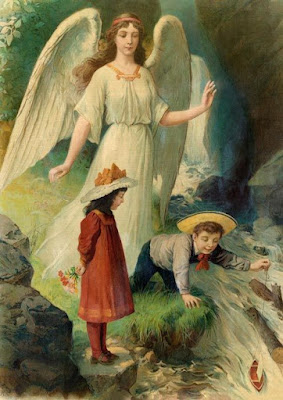
Here is Saint Newman's 1853 hymn "Guardian Angel," for yesterday's October 2nd Feast of the Guardian Angels.

         
         GUARDIAN ANGEL

My oldest friend, mine from the hour
   When first I drew my breath;
My faithful friend, that shall be mine,
   Unfailing, till my death;

Thou hast been ever at my side;
   My Maker to thy trust
Consign'd my soul, what time He framed
   The infant child of dust.

No beating heart in holy prayer,
   No faith, inform'd aright,
Gave me to Joseph's tutelage,
   Or Michael's conquering might.

Nor patron Saint, nor Mary's love,
   The dearest and the best,
Has known my being, as thou hast known,
   And blest, as thou hast blest.

Thou wast my sponsor at the font;
   And thou, each budding year,
Didst whisper elements of truth
   Into my childish ear.

And when, ere boyhood yet was gone,
   My rebel spirit fell,
Ah! thou didst see, and shudder too,
   Yet bear each deed of Hell.

And then in turn, when judgments came,
   And scared me back again,
Thy quick soft breath was near to soothe
   And hallow every pain.
*            *            *            *
And thou wilt hang about my bed,
   When life is ebbing low;
Of doubt, impatience, and of gloom,
   The jealous, sleepless foe.

Mine, when I stand before the Judge;
   And mine, if spared to stay
Within the golden furnace, till
   My sin is burn'd away.

And mine, O Brother of my soul,
   When my release shall come;
Thy gentle arms shall lift me then,
   Thy wings shall waft me home.

John Henry Newman, Hymns, Dimension Books: Denville, NJ, 1983, 179-181.

Sunday, October 2, 2022

"Island" (Остров), Pyotr Mamonov 2006


I offer here a quote from Caussade, Self-Abandonment to Divine Providence, Tan:Charlotte, NC, 2012, 357-358, which captures well the penitential trust of holiness portrayed in the film.

You cannot, you say [dear Sister], report anything to me, other than your wretchedness--I can well believe you, since, as long as we are in this life, we can but find ourselves for ever most wretched and imperfect. Do you desire a remedy that will effectively cure all this wretchedness? Here you have it: while abominating the sins which are the cause of them, cherish, or at least accept, their consequences, namely, the self-abjection and self-scorn which follow them. Yet in every case do so without vexation or grief, anxiety or discouragement. Do not forget that God, though he does not desire sin, makes a very useful instrument of it to keep us at all times in abjection and self-scorn. but for this bitter remedy we should soon give way to the intoxication of self-love. Be guided by me: remain steadfast in contentment, firm and tranquil in the midst of your wretchedness, while striving to decrease it. The greater progress you make spiritually, the more such wretchedness you will encounter. It is their ever more clearly recognized perception of their insignificance which strengthens the humility of the saints. Yet this humility, in God's sight, is for ever joyous and peaceful. It reaches the stage of cherishing spiritual poverty, and so automatically converts that poverty into riches. Recollect that it is beneath the dunghill of our wretchedness that God conceals the gifts he makes us. This to protect them from self-love's complacency and our futile self-esteem.

I do not blame your tears; yet I wish that when the poignancy of your grief finds expression in them, you would take care to shed them both for, and before, God. By this means you will feel, not bitterness, but a secret spiritual sweetness that will develop interior peace within you by instilling in you complete submission to every desire of God.

__
Pyotr Mamonov, an Orthodox monk, was a prominent figure in Russia's cultural scene for decades, having been a rock musician, poet and actor.

After founding the rock group Zvuki Mu (Sounds of Mu) in 1982, Mamonov became an underground cult figure in Moscow. He gained wider recognition after Soviet restrictions on rock music and alternative culture were lifted in the late 1980s as part of then-leader Mikhail Gorbachev's reforms.

Mamonov further expanded his fame through acting. He performed in numerous films and theater productions in the 1990s.

In the 1990s, Mamonov became deeply religious, converted to Orthodox Christianity, left the capital and settled in a village. He made a triumphant comeback as an actor, starring as a devout Russian Orthodox monk in Pavel Lungin's 2006 movie “Island” and as Russian Czar Ivan the Terrible in Lungin's 2009 film “Tsar.”

Mamonov suffered a heart attack and underwent a surgery in 2019. He died on Thursday, 15 July 2021 at the age of 70.

Russian Culture Minister Olga Lyubimova hailed the musician-actor as “bright, charismatic and strong.

The head of the Russian Orthodox Church, Patriarch Kirill, praising the actor said that Mamonov's remarkable portrayal of religious characters was possible because of his spiritual experience.

According to Kirill, Mamonov used “the language of art to talk to viewers about eternal subjects: life and death, the sense of being and the value of good, internal struggles and the importance of heeding the voice of conscience.

Saturday, October 1, 2022

Giorgia Meloni at National Conservatism


Here is the new Prime Minister of Italy speaking in English.

Here she is in a speech from the past few days, after her election.

Nothing Fascist her! Sky News Australia

Tuesday, September 27, 2022

Giorgia Meloni: "God, Family, Country"

Two videos promoting our Western-civilization by the new Italian Prime Minister. Viva Italia!

We won't let the enemy define us!
The enemy of God, the enemy of Christ, the enemy of the family, the enemy of male and female, the enemy of freedom and of the individual conscience, the enemy of common sense.

Here she is in Spanish, on the defense of our true Christian, European civilization, and on the promotion of the true patriotic voices.
Hay que decir que si! Y hay que decir que no!

Meloni arrasa...con dos melones!

Saturday, September 24, 2022

Cardinal Müller on Papal Ministry


Cardinal Gerhard Ludwig Müller, the former Prefect of the Congregation for the Doctrine of the Faith, granted an interview to InfoVaticana, affirming that the Pope does not have the authority to change the teaching of the Church.

The cardinal responded with candor to questions of that news agency, entering fully into the questions raised about the recent consistory of cardinals held in Rome at the end of August and about the dramatic situation that the Church is experiencing in Germany.

Cardinal Müller had just finished preaching spiritual exercises to more than 400 priests in Poland. Müller will visit Spain next October. On October 25th he will participate in a conference in Madrid on “John Paul II and the New Evangelization. Source of Moral and Spiritual Renewal."

Interview with Cardinal Gerhard Ludwig Müller

Q-A few weeks ago you participated in the Consistory of the Cardinals in Rome, with what feelings did you conclude the work at that time?
A-First of all, I thanked the Holy Father for reconvening a consistory after a pause of many years so that the cardinals could discuss with him the situation of the Church in today's world. But the topic was limited to the discussion of the already published document Praedicate Evangelium on the reform of the curia and on the Holy Year 2025.

Q-There are some cardinals who regret not having been able to speak as much as they would have liked. Was there an opportunity for the cardinals to express their concerns to the pope?
A- There was no opportunity to discuss the burning issues, for example, about the frontal attack on the Christian image of man by the ideologies of posthumanism and gender madness or about the crisis of the Church in Europe (there are no priestly vocations, churches are empty on Sundays, etc.). Critical contributions referred to the theory of the papacy as an unlimited power of divine right over the entire Church, as if the pope were a Deus in terris. The newly appointed Cardinal Ghirlanda, SJ, as the pope's top adviser on curial reform, holds the view that everything popes have said or done in the course of church history is either dogma or law, de jure divine. This contradicts the entire Catholic tradition, and especially Vatican II, that bishops and priests only have authority to perform sacramental acts, while the pope has exclusive possession of all jurisdiction, which he can delegate at will to clerics or laity. Indeed, in the sacrament of Holy Orders, Christ confers on the bishop (or priest) the authority to preach, sanctify, and govern (even to administer justice). The pope does not confer jurisdiction on a bishop, but only assigns a specific diocese to a bishop, who is not a representative of the papacy, but of Jesus Christ (Lumen Gentium 27). In an ecumenical council, the consecrated bishops exercise their part in the jurisdiction of the universal episcopate not as delegates of the pope, but by virtue of the authority conferred on them by Christ. The theory of the pope as autocrat, borrowed from 19th century Jesuit theology, not only contradicts the Second Vatican Council, but undermines the credibility of the Church with this caricature of the Petrine ministry. The promise of an ecumenical mediation of the Catholic doctrine of the Pope (cf. Encyclical of John Paul II Ut unum sint, of 1995) as "perpetual and visible principle of the unity of the Church in the truth of Christ" (cf. Lumen gentium 18; 23) becomes frankly ridiculous.

Q- What issues would you highlight as currently of greatest importance in the Vatican?
R-By “Vatican” we understand the accidental institutions of the Holy See. But I speak here of the ministry of the Roman Church, that is, of the pope with the College of Cardinals (and the institutions of the Roman curia) to the communion and unity of all the local Churches in the truth of divine revelation and the sacramental mission to lead all men to the knowledge of Christ, the Son of God and the only mediator of salvation.

Q- A somewhat controversial question: why is there more and more talk in the Church about topics such as ecology, the planet or other topics, and less about Jesus Christ and his teachings?
R-In a world in which the meaning and goal of the human being are materially limited to temporary and transitory contents (such as the acquisition of power, prestige, money, luxury, pleasurable satisfaction), it is easier to become interesting as an agent of this program of a «New World Order without God» (according to capitalist or communist readings). "For what good will it be for a man to gain the whole world, if he loses his soul?" (Mt 16,26). If we want to be disciples of Jesus, we must also obey his word: "Seek rather his kingdom, and the rest will be given to you" (Lk 12:31). There is no strict opposition between the eternal/spiritual goods and the temporal/perishable necessities of life. But first we ask God, our Father, that his Kingdom come and that his holy Will be done in heaven as it is on earth. And we also ask for daily bread, the forgiveness of our sins as we also forgive those who offend us, and salvation from all the evils derived from our sinful separation from God, as the origin and goal of every human being.

In his succession of Saint Peter, the Pope daily unites the whole Church in the confession of Jesus: "You are the Messiah, the Son of the living God" (Mt 16:16). And Christ builds his Church on Peter, the rock, giving him and the bishops the authority to proclaim the Gospel of the Kingdom of God, administer the Sacraments and, as good shepherds, lead the flock of Christ to the good pasture of the Word and of grace.

Q- The whole Church follows with attention and concern the steps of the German Synodal Path. What do you think of the decisions of the IV Assembly of the German Synodal Path?
R-In theatrical language, one would not know exactly whether to speak of tragedy or comedy with respect to this event. All the texts, very abundant but not very deep, do not deal with the renewal of Catholics in Christ, but with a surrender to a world without God. The only theme among all the themes is sexuality. However, it is not understood as the gift of God granted to human beings as created persons (in our masculine and feminine nature), from which derives the responsibility to participate as father and mother in the work of God's Creation and the universal will of salvation for one's own offspring, but as a kind of drug to numb the basic nihilistic feeling with the maximum satisfaction of pleasure.

Q-Both Cardinal Marx and Georg Bätzing supported the texts that asked the pope for a change in sexual morality, the ordination of women and the vision of homosexuality, what do you think?
A- There are two errors in this that only the theologically ignorant can make: 1) the pope has no authority to change the teaching of the Church, which is based on God's revelation. By doing so, he would exalt himself as a man above God. 2) the apostles can only teach and order what Jesus commanded them to teach (Mt 28:19). It is precisely the bishops, and their successors, who are called to the "teaching of the apostles" (Acts 2,42) in Sacred Scripture, the Apostolic Tradition and the accurate doctrinal definitions of previous papal ex cathedra decisions or of ecumenical councils. “The Roman Pontiff and the Bishops […] do not accept any new public revelation as belonging to the divine deposit of faith” (Lumen gentium 25; cf. Dei verbum 10).

Q-Have you had the opportunity to speak with any of the German bishops who hold these positions?

R-According to the logic of power, which shuns the truth like the devil does holy water, it makes no sense for them to talk to the former prefect of the Dicastery for the Doctrine of the Faith. But even Cardinal Kasper, who was previously celebrated as an ally in the question of the communion of the divorced and remarried, is silenced by them after his statements critical of the synodal path.

Q-What do you think is the reason for trying to reform the Church by changing all the morals, principles, teachings and traditions?
A-Many well-paid officials in the "German Church" company establishment (as the largest employer in Germany) suffer from the fact that the Church's teaching on marriage and the 6th and 9th commandments of the Decalogue contradict mainstream belief of society from the sexual revolution of 1968. They cannot bear the contradiction with the will of God in their personal behavior and the derisive comments of their contemporaries about the «Catholic world of faith and morals left behind in the Middle Ages». That is why they also want to project themselves as modern and follow the forefront of the science of psychology and sociology. They want to be there and not be seen as outsiders (as the "sordid son of the nation," as the Bishop of Aachen lamented).

Q- Do you think that the Church in Germany runs the risk of starting a schism with Rome?
R-In their blind arrogance, they do not think of division, but of taking over the universal Church. Germany is too small for them to exercise their governing ideology. They claim a leading role in the universal Church. It is about nothing less than pleasing the whole world with its wisdom and freeing backward and uneducated Catholics and their bishops from other countries, including the pope, from the burden of divine revelation and the Commandments. Its goal is the transformation of the Church of the Triune God into a worldly welfare organization (NGO). Then we would have finally arrived at the "religion of universal brotherhood", that is, at a religion without the God of revelation in Christ, without a Truth that reaches beyond finite reason, without Dogmas and Sacraments as necessary means of Grace necessary for salvation, as described by the great Russian philosopher of religion Vladimir Soloviev in his writing A Brief History of the Antichrist (1899). The world ruler of universal philanthropy without God is contradicted here by Pope Peter II, who launches the following confession to the Antichrist who has installed himself on the throne of God: «Our only Lord is Jesus Christ, the Son of the living God».

Q-What do you think the future will hold for the Catholic Church at a universal level?
R-When one sees the megalomania of our politicians and ideologues from Beijing to Moscow and from Brussels to Washington, one cannot expect much good for the future of humanity. We can only expect a true future for every human being in life and in death from God, who out of love gave his Son for the salvation of the world (cf. Jn 3:16). In a world in which men presume to be God, to create and redeem themselves (cf. the main counselor of the New World Order: Yuval Noah Harari, Homo Deus), Christians only have the testimony of the Word and, if necessary, of blood, that only the God and Father of our Lord Jesus Christ is our Savior, because he has defeated the world, its arrogance and its sin and death as the price for sin.

Only when we do not worship "the beast" from the bottomless pit (ungodliness), his statue, and his false prophet, do we attain life and dominion with Christ, which encompasses our temporal and eternal future. Because temporal and eternal death no longer has power over us (cf. Ap 20,6). We have peace of heart in the Son of God, who says to his disciples: «In the world you will have struggles; but have courage: I have overcome the world» (Jn 16,33).

Plinthos translation.

Friday, September 23, 2022

The Last Message of Francisco Franco Bahamonde


Spaniards:

As the time approaches for me to surrender my life before the Most High and appear before His non-appealable judgment, I ask God to welcome me benignly into his presence, because I wanted always to live and die as a Catholic. In the name of Christ I take pride in being, and it has been my constant will to be, a faithful son of the Church, in whose bosom I am going to die. I apologize to everyone, as I wholeheartedly forgive all those who declared themselves my enemies, without me having them as such. I believe and so I hope that I have had no enemies other than those who are enemies of Spain, which I love until my last moment and which I promised to serve until the last breath of my life, which I know is already coming.

I want to thank all those who have collaborated with enthusiasm, dedication and self-denial, in the great undertaking of making a united, great and free Spain. Because of the love I feel for our country, I ask you to persevere in unity and peace and to surround the future King of Spain, Don Juan Carlos de Borbón, with the same affection and loyalty that you have given me and give him, at all times, the same collaborative support that I have had from you.

Do not forget that the enemies of Spain and of Christian civilization are alert. You too, be vigilant, and, for this, set aside all personal concerns before the supreme interests of the homeland and the people of Spain. Do not give up on achieving social justice and culture for all the men of Spain and make it your main objective. Maintain the unity of the lands of Spain, extolling the rich multiplicity of its regions as a source of the strength of the unity of the homeland.

I would like, in my last moment, to unite the names of God and Spain and embrace you all to shout together, for the last time, on the threshold of my death,

Forward Spain! Long live Spain!


Españoles:

Al llegar para mí la hora de rendir la vida ante el Altísimo y comparecer ante su inapelable juicio, pido a Dios que me acoja benigno a su presencia, pues quise vivir y morir como católico. En el nombre de Cristo me honro, y ha sido mi voluntad constante ser hijo fiel de la Iglesia, en cuyo seno voy a morir. Pido perdón a todos, como de todo corazón perdono a cuantos se declararon mis enemigos, sin que yo los tuviera como tales. Creo y deseo no haber tenido otros que aquellos que lo fueron de España, a la que amo hasta el último momento y a la que prometí servir hasta el último aliento de mi vida, que ya sé próximo.

Quiero agradecer a cuantos han colaborado con entusiasmo, entrega y abnegación, en la gran empresa de hacer una España unida, grande y libre. Por el amor que siento por nuestra patria os pido que perseveréis en la unidad y en la paz y que rodeéis al futuro Rey de España, don Juan Carlos de Borbón, del mismo afecto y lealtad que a mí me habéis brindado y le prestéis, en todo momento, el mismo apoyo de colaboración que de vosotros he tenido.

No olvidéis que los enemigos de España y de la civilización cristiana están alerta. Velad también vosotros y para ello deponed frente a los supremos intereses de la patria y del pueblo español toda mira personal. No cejéis en alcanzar la justicia social y la cultura para todos los hombres de España y haced de ello vuestro primordial objetivo. Mantened la unidad de las tierras de España, exaltando la rica multiplicidad de sus regiones como fuente de la fortaleza de la unidad de la patria.

Quisiera, en mi último momento, unir los nombres de Dios y de España y abrazaros a todos para gritar juntos, por última vez, en los umbrales de mi muerte,

¡Arriba España! ¡Viva España!


The pretender to the French throne, King Louis XX, Duke of Anjou and Bourbon, is a Spaniard, a practicing Catholic, and a descendant of Francisco Franco. His full name is Luis Alfonso Gonzalo Víctor Manuel Marco de Borbón y Martínez-Bordiú and lives in New York City with his wife and children.

Thursday, September 22, 2022

The "Man on the Moon" Lie: Sibrel.com

Here are a couple of videos claiming that "the moon landing" was a fake, yes, a conspiracy!

N.B. "Theories," conspiracy or otherwise, are not matters of belief but of investigation. Theories ask intelligent questions and it is up to researchers and evidence to attempt to adequately answer those questions.


A documentary on the evidence which shows that the Apollo 11 astronauts never actually landed on the moon. Cf. Bart Sibrel.

"Moon Landing Hoax Confession"
Gene Gilmore (Birth name: Eugene Rueben Akers)

Here is the note under this video regarding the book by Bart Sibrel, Moon Man.

ORDER THE BOOK MOON MAN: THE TRUE STORY OF A FILMMAKER ON THE CIA HIT LIST https://www.sibrel.com/ One year to the day after the publication of the revelatory book "Moon Man: The True Story of a Filmmaker on the CIA Hit List", which divulges the deathbed confession of the former Chief of Security at Cannon Air Force Base in Clovis New Mexico, who confessed thereon to his participation in the falsification of the first "moon landing", his identity is finally revealed. This predetermined waiting period was previously negotiated with his sole surviving son, who himself passed away this year. Cyrus Eugene Akers detailed the information in the book, including not only the location of the filming of the first fake moon landing at his military base, the dates it was filmed, and the CIA codename for the operation, he also gave the names of fifteen government scientists and officials who were allowed exclusive observation of this historic government fraud, some of whom are still alive today. The list was given to Akers by President Lyndon Johnson, who was there at the first day of filming. Threatened with execution if he ever revealed this information, Security Chief Akers kept all of this to himself until his deathbed, the guilt from which prompted his tearful confession to his son, who was also threatened with assassination after sharing this information with the author of Moon Man, Bart Sibrel. This sad and outrageous, and really unnecessary deception, was done for pride and embezzlement. It demonstrates the complete arrogance of leaders over their people, who in fact are financing their own deception. Unlike government frauds about war, assassination, or terrorism, the moon landing deception cruelly gave the over-trusting public the pleasing candy that they cried out for. Trying to take it away from them, after they believed with tears and cheers, by exposing their heroes as the criminals they really are, faces fierce resistance. Even a professor at a major university has so famously said, "Even if I heard a moon astronaut confess that he never really went, I would still believe that he walked on the moon." Fortunately a new generation is here, ones who were not emotionally branded by the deception, who are objective to the unfolding reality of the moon landings falsification. Simply put, what the corrupt government is claiming, is that in 1969 they went from never being in space, to walking on the moon, with only 8 years of research and development, and that with one-millionth the computing of a cell phone, and on the first attempt, when even the South Pole on Earth was not reached on the first attempt. Today, with 50 years of more advanced rocket and computer technology, the current Artemis moon rocket took 18 years to develop, had three launch failures, is not safe enough yet to carry astronauts, and will only orbit the moon, because a moon lander for it has not yet been developed that works. The farthest that the government can send astronauts today, 50 years later, is to the space station, which is only one-thousandth the distance to the moon. For the first time in the entire history of the world, technology was greater in the past than in the future. As this is actually impossible, it only means one thing, that the 1969 moon landing was a forgery. It is not the first time scientific boasts were falsified or governments have lied, as covid vaccine maker Prizer has been fined billions of dollars, on multiple occasions, for making fraudulent claims about their scientific products. Former high-ranking government employee Robert McNamara, who was Defense Secretary during the Vietnam War, admitted before he died that the "Gulf of Tonkin Incident", which was the reason why the war began, was completely fabricated by the CIA. If the corrupt government is willing to falsify something that led to the death of a million people, including 58,220 of their own citizens, then I think they are capable of faking an image on a television. All Truth passes through three stages. First, it is ridiculed, Then it is violently opposed, Finally it is accepted as self-evident. Arthur Schopenhauer In an age of universal deceit, telling the Truth is a revolutionary act. Whoever controls the past, controls the future. George Orwell One of the saddest lessons of history is this: If we’ve been bamboozled long enough, we tend to reject any evidence of the bamboozle. We’re no longer interested in finding out the Truth. The bamboozle has captured us. It’s simply too painful to acknowledge, even to ourselves, that we’ve been taken. Once you give a charlatan power over you, you almost never get it back. Carl Sagan It is easier to fool people, than to convince them that they have been fooled. Mark Twain Sibrel has been interviewed and appeared on The Tonight Show, The Daily Show, Geraldo, The Abrams Report, Coast to Coast, NBC, CNN, FOX, HBO, Time Magazine, the New York Times, the L.A. Times, the Washington Post, and USA Today


911 IN PLANE SITE

While on the Subject of Conspiracy Theories, here is another great video on alleged conspiracies. "911 In Plane Site" by William Lewis, written by Dave Vonkleist. In early 2002 I ordered and received a free copy of this excellent investigative journalism by responding to a New York Times advertisement which was offering it.

Here is the note with the YouTube video of
Dec 11, 2010 with 1.1 Million views.

If A Picture Is Worth A Thousand Words, What Is A Video Worth? What "In Plane Site" accomplishes that no other video expose' on September 11th has to date, is it exposes the viewer to a barrage of news clips from a majority of the mainstream news outlets. The official story of that day was told on live TV by reporters, policemen, firefighters, and other on-the-scene eyewitnesses, however, that footage was shown only once on live television broadcasts in the first hours of the attacks and then... it was never repeated. The stories changed, information was enigmatically omitted, and what can only be described as officially prescribed propaganda took the place of indisputable reality. THE PENTAGON: Some of the most damning evidence surrounding the attack on the Pentagon centers about substantial and incontrovertible video and photographic evidence which insights viewers to ask crucial and essential questions. After all, the laws of physics cannot be suspended or can they? One question many viewers ask is, "why was America and the rest of the world not shown the video footage and the photographs of the Pentagon, BEFORE the outer wall had collapsed?" Many people do not realize that the outer wall of the Pentagon did not collapse until 20 minutes after the initial impact of what we were told was a Boeing 757. Upon examining these photographs, one can clearly see a hole, which is only 16 feet in diameter. This begs the question: "How can a Boeing 757 which is over 44 feet in height and 124 feet in width simply disappear without a trace into a hole that is only 16 ft. in diameter? Also, why is there no external damage to the Pentagon where the wings and the tail section would have impacted with the outer wall? Contrary to the video footage shown to the American public, photographs taken only moments after the impact show no wreckage on the lawn of the Pentagon. Where is the plane? Where are the wings, the tail, the luggage, the seats, the landing gear, and the engines? Most importantly, what happened to the passengers who were aboard that plane? America remembers the photographs that they were shown of tiny, indiscernible fragments, which were described as pieces of a Boeing 757. Were these fragments of a Boeing 757? Internal photographs of the Pentagon taken by Jocelyn Augustino, a FEMA photographer, do not show engine parts matching the description of a 757's engine turbofan according to John W. Brown, a spokesperson for Rolls Royce. Both Pratt & Whitney and Rolls Royce manufacture the engines used on these jetliners. The turbofans themselves are approximately 7 feet in diameter. The FEMA photos show what appears to be a single turbofan that is approximately 3 feet in diameter. This better fits the descriptions of eyewitnesses who claim that they saw what could only be described as a commuter plane capable of holding only 8 to 12 passengers. This single piece of evidence also helps support other reports from witnesses such as Lon Rains, editor for "Space News," who was quoted as saying "I heard a very loud, quick whooshing sound. I was convinced it was a missile. It came in so fast -- it sounded nothing like an airplane." Don Parkal said, "A bomb had gone off. I could smell the cordite. I knew explosives had been set off somewhere." Tom Seibert said, "We heard what sounded like a missile."
Related Posts Plugin for WordPress, Blogger...